Tours
Photographic China
Fourteen days chasing the light rather than the monuments. Times set by the viewpoint.
At a glance
- Days
- 14
- Nights
- 13
- Who it suits
- Amateur and professional photographers · 30 to 55 · experienced travellers
- Price per person
- US$ 3.800 a 5.200
Day by day
Fourteen days built from behind the camera: this itinerary is not about cities, it is about hours. Every day has a scheduled first light and a planned sunset, with lodging inside or beside the park so that half a morning is not lost to transfers.
A photographic trip to China comes down to two decisions: where to sleep and what time to leave. We sleep inside the parks whenever we can — in Zhangjiajie and in Yuanyang the difference between being at the lodging and being an hour’s drive from the viewpoint is the difference between photographing the mist and arriving after it has lifted. The day is structured from the hour of the sun, not from breakfast.
This is not a tour for seeing a lot. There are three places — Zhangjiajie, the Li River and the Yuanyang terraces — and we do not add a fourth, because what these three ask for is repetition: returning to the same viewpoint on two mornings of different light is worth more than a new city on a grey morning. It is also why the itinerary carries two buffer mornings, one in each area, deliberately left open.
The guide has a different job on this route: carrying the tripod, holding a place on narrow viewing platforms, knowing which way the mist turns and when the water on the terraces goes mirror-flat. It is a private tour, assembled from two people, which lets us fit the timings to each day’s decisions rather than imposing them the night before.
How we organise it
As a travel agency for China with a team on the ground, we work from cloud-cover and relative-humidity forecasts in the week before each stage, and reorder the sessions according to what turns up. In the right season, between December and March, the terraces are flooded and act as mirrors; in April and May there is almost guaranteed mist in the mountains. In Yuanyang you sleep in thatched-roof Hani villages, with simple facilities but minutes from the viewpoint — a deliberate choice, explained before you book.
We do not include drones in the programme. Drone use in China requires prior authorisation and there are many prohibited zones, national parks among them; for aerial work we handle the request case by case. Tripods are accepted almost everywhere except museums, and we always carry a spare.
What the price includes
- English-speaking guide with photographic practice, who knows the hour of the light at every viewpoint
- Private driver and vehicle, with extended hours for sunrises and sunsets
- Thirteen nights in lodging chosen for its proximity to the viewpoints, inside the parks where possible
- High-speed trains Zhangjiajie–Guilin and the flight or train Guilin–Kunming, in the upper class
- Entrance to all parks, cable cars and viewpoints, including early access where it exists
- Tripod-carrying assistance and daily light planning based on the weather forecast
- Local data SIM card and permanent phone support in English
- Spare tripod and transport of gear between viewpoints by the guide
- Daily check of cloud and mist forecasts, with sessions reordered accordingly
What the price does not include
- International flights to and from China
- Chinese visa and any permits for professional filming
- Camera equipment and insurance for gear
- Meals not listed, drinks and tips for guide and driver
- Personal expenses and optional extensions
01Day 1
Arrival in Zhangjiajie
Afternoon and evening. Pick-up at the airport and transfer to the lodging inside the park area, close to Yuanjiajie. Equipment check with the guide and planning of the week’s light. Meal. Dinner in the village and an early night.
Meals: dinner.
02Day 2
Yuanjiajie at sunrise
Morning. At the gates of the Bailong elevator by 7am, before the public cable cars open. The Yuanjiajie walkway with the sandstone pillars still holding mist at the bottom of the valley.
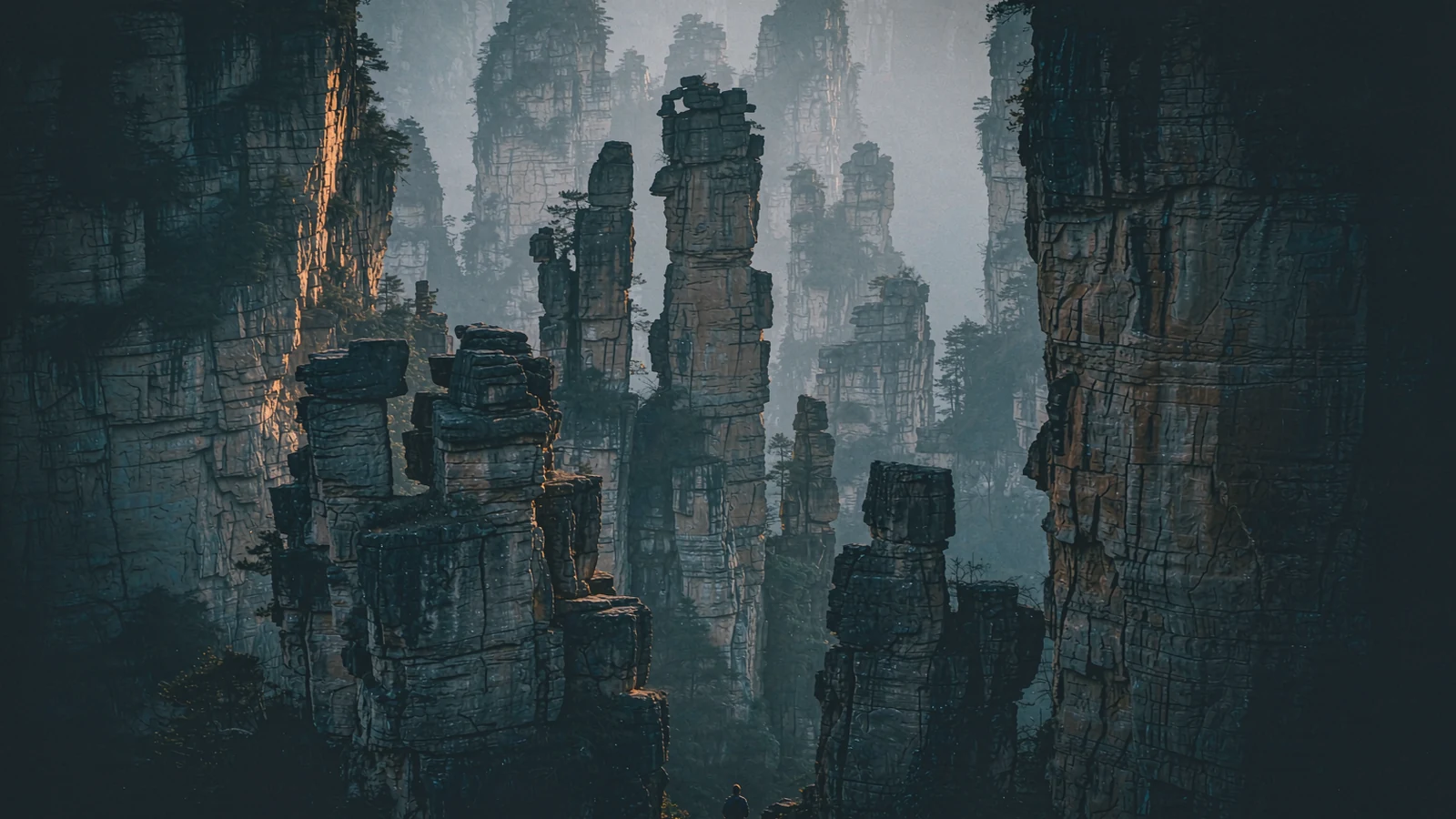
The Yuanjiajie pillars at sunrise. The sandstone columns climb out of the forest and the mist stays trapped at the bottom of the valley, which is what separates the layers of the frame. Afternoon. Rest, review of images, and a return session on Tianzi Mountain for the afternoon light.
The sandstone pillars of Zhangjiajie are what is left of a plateau that erosion cut away over millennia: more than three thousand columns, some over two hundred metres tall. With mist in the valley floor the reading is of a floating forest; without it, the same frame loses half of what it has. That is why we insist on access before the public cable cars open, and why the reserve morning on Day 5 exists. Evening. Dinner and a planning session for the next day, based on the forecast.
Meals: breakfast and dinner.
03Day 3
Tianzi Shan and the valley floor
Morning. Cable car up Tianzi Shan for sunrise over the range of pillars at 1,200 metres. Afternoon. Golden Whip Stream, seven flat kilometres with pillars overhead and light coming in sideways between the columns. Evening. Dinner at leisure and rest.
On days of dense mist the summit sits inside the cloud and the best composition is halfway down the slope: the guide decides on the spot, from what the previous morning looked like, and we drop a cable car stop when there is nothing to see up here. Golden Whip Stream, for its part, is the only long flat stretch in the park and rewards slow exposures, in which the water turns silky.
Meals: breakfast and lunch.
04Day 4
Heaven’s Gate
Morning. Tianmen Shan: a seven-and-a-half-kilometre cable car, the longest in the world without intermediate stops, and the natural arch in the mountain. Afternoon. The road of 99 bends photographed from above, and the glass walkways clinging to the cliff. Evening. Transfer to the town and dinner of Hunan cooking.
Meals: breakfast and dinner.
05Day 5
Zhangjiajie to Yangshuo
Morning. Reserve session: repeat the viewpoint that rain cost you. If it is already done, a free morning. Afternoon. Train to Guilin and a 1h15 transfer to Yangshuo. Evening. Check in on the bank of the Li River and reconnaissance of the raft landing spot.
Meals: breakfast and dinner.
06Day 6
The Li River at sunrise
Morning. Departure at 4:30 for the Xianggong viewpoint: the bend of the Li River with the karst peaks emerging from the mist. It is the most reproduced image in southern China, which is why the climb to the viewpoint is made in the dark, with torches, to secure a place on the platform. Afternoon. Rest, then a bamboo raft on the stretch from the 20-yuan note in the low light of late afternoon.
The jetty fills with motorised boats from 10am, so the raft runs late in the day and over a short stretch: that is when you work with long exposures and still water.
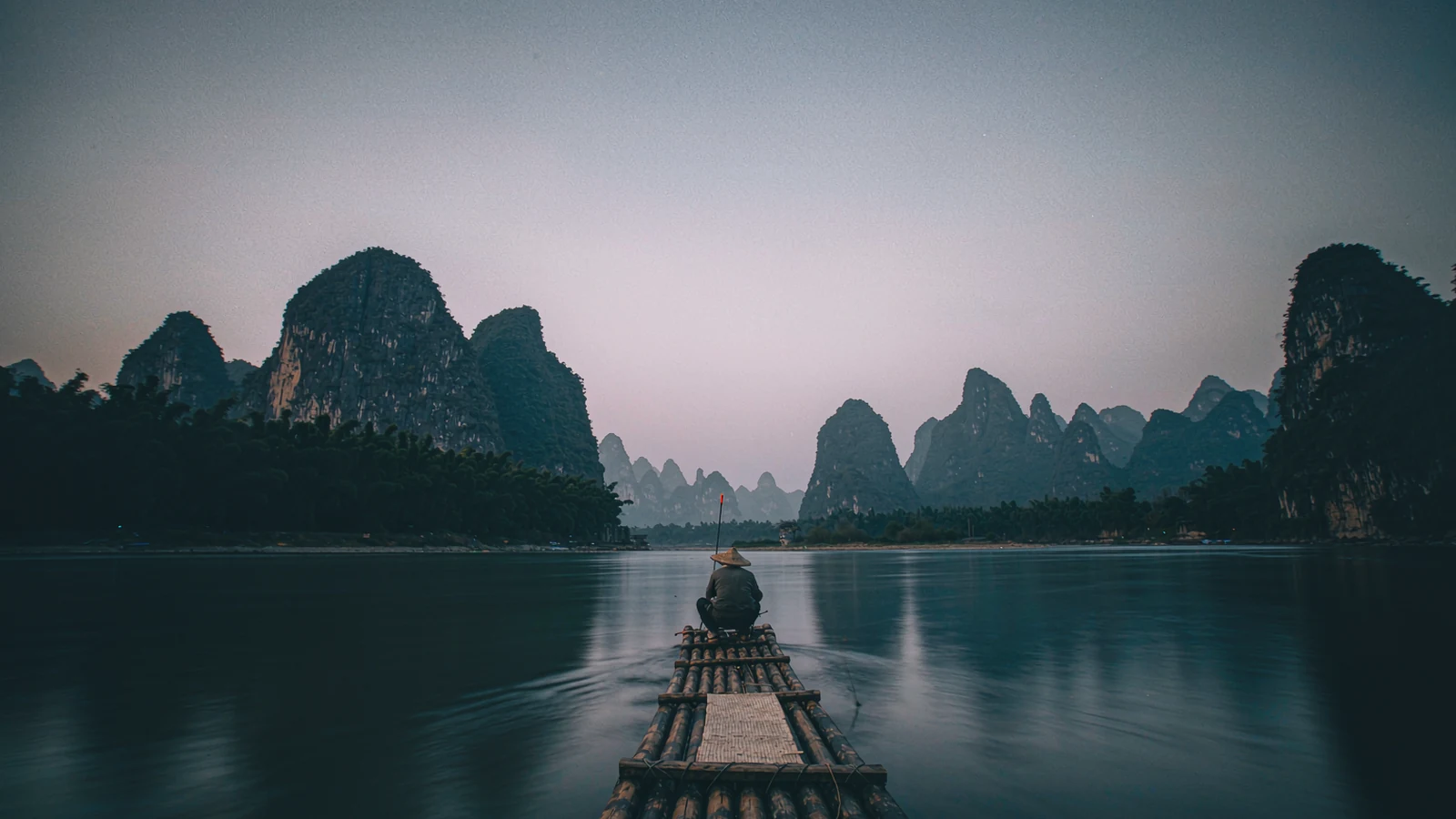
A bamboo raft on the bend of the Li River. The boats run without a motor and sit low in the water, which lets you close in on the peaks without noise. Evening. Dinner on the bank and a joint review of the day’s images.
Meals: breakfast.
07Day 7
The rice fields and the fishermen
Morning. Fishermen with their cormorants at dawn on the Li River — a session arranged with a local fishing family. Afternoon. Bicycle route to the villages of the Yulong River, with stone bridges and buffalo in the fields. Evening. Dinner at a tangerine farm at sunset.
Meals: breakfast and dinner.
08Day 8
Yangshuo to Kunming
Morning. Last short session on the jetty before breakfast, with the fishing nets drying. Afternoon. Transfer to Guilin and flight or train to Kunming. Check-in. Evening. Dinner of wild mushrooms, a Yunnan speciality, and preparation for Yuanyang.
Meals: breakfast and dinner.
09Day 9
Towards Yuanyang
Morning. The Stone Forest, two hours away: limestone towers 270 million years old, with a local guide to get off the shuttle route. Afternoon. The road to Yuanyang, five to six hours, arriving in time to reconnoitre the viewpoints. Evening. Check in at the Hani village, inside the terraces.
Meals: breakfast and dinner.
10Day 10
Yuanyang: sunrise on the terraces
Morning. Duoyishu viewpoint at 6:30: the flooded terraces act as mirrors and reflect the whole sky. Between December and March, when the fields are flooded, this is the finest agricultural spectacle in the world. Afternoon. Thatched-roof Hani villages and a portrait session arranged with local residents, with prior permission. Evening. Dinner in the village and rest.
Meals: breakfast and dinner.
11Day 11
Sunset at Laohuzui and Bada
Morning. Session at the market in the neighbouring village: Yi and Hani minorities in their dress. On market days only. Afternoon. Laohuzui viewpoint for the sunset over the terraces cascading a thousand metres down the slope.
Here the sunset is worth more than the sunrise. Laohuzui has the drop on the right side: the terraces run down the entire hillside and the water gives back the colour of the sky for the last twenty minutes of light.
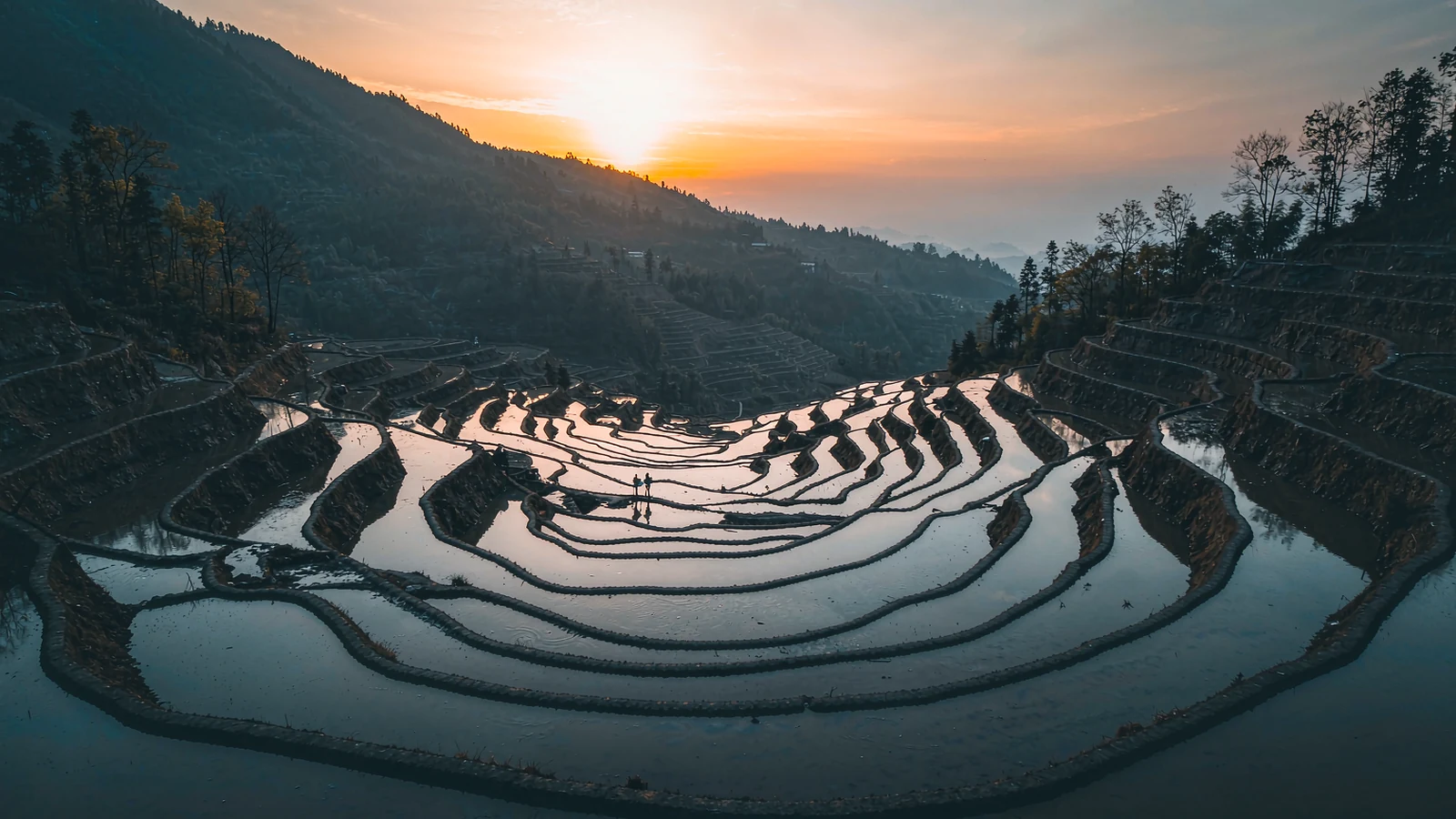
The Yuanyang terraces at sunset, near Laohuzui. Between December and March the fields are flooded and every terrace works as a mirror. Evening. Dinner of terrace rice and ham cured at altitude.
Meals: breakfast and lunch.
12Day 12
Yuanyang to Dali
Morning. Last reserve dawn on the terraces, according to whatever the previous days missed. Afternoon. Road and train to Dali, beside Erhai lake. Arrival at the end of the day. Evening. Check-in and a night walk through the old town of the Bai.
Meals: breakfast.
13Day 13
Dali and Erhai lake
Morning. Sunrise over Erhai lake, with the 4,000-metre range on the far side, from the eastern shore. Afternoon. Fishing villages and the Shazhou market, street portraits and wooden boats. Evening. Farewell dinner and a final review session of the best images of the trip.
One note on the Yi and the Hani: photographing people in traditional dress is a negotiation, not a right. We always arrange it in advance, we pay when payment is asked for, and we do not press when the answer is no. Almost every portrait that comes out of this trip is of someone who said yes.
Meals: breakfast and dinner.
14Day 14
Return
Morning. One last short session in the old town streets before the crowds, then breakfast. Afternoon. Transfer to Dali airport, or an extension to Lijiang and Shangri-La for anyone with more days.
Meals: breakfast.
Three things you will not repeat
01
Sunrise at Yuanjiajie, Zhangjiajie, before the public cable cars open
02
The Yuanyang terraces at sunset, in the flooded season
03
A guide who works as an assistant: carries the tripod, holds the spot and watches the clock
Price
US$ 3.800 a 5.200
Per person · 14 days · 13 nights
Land portion in China, double room, excluding international flights. From 2 travellers.
What's included
- Land transport in China: high-speed rail and domestic flights as listed
- Portuguese-speaking guide from the first day to the last
- 4-star hotels, double room
- Entry tickets to the monuments listed in the itinerary
- Daily breakfast
What's not included
- International flights to and from China
- Visa and consular fees
- Meals not listed in the itinerary
- Tips and personal expenses
Frequently asked questions
Do I need a tripod?
Recommended for the sunrises and for long exposures on the terraces. We carry a spare tripod and the guide moves it between viewpoints, which is one of the reasons clients ask us to escort them. There are places where tripods are not allowed; we flag those in advance.
How physically demanding is it?
Moderate to demanding. You are up at 4:30 on six of the fourteen mornings, and you walk with gear on your back up stone staircases at Tianzi and in Yuanyang. This is not a tour for anyone who wants to sleep in: it is a tour built around the hour of the light.
Is a visa needed, and are there extra permits?
A tourist visa for mainland China is needed, handled by us at least a month ahead. Drone photography always requires prior authorisation and there are many prohibited zones; we do not include a drone in the programme and advise against carrying one without a licence. Tripods are accepted in most places, with the exception of museums.
Is there a single room supplement?
Yes, between US$ 680 and US$ 980 for the fourteen days, because we sleep in villages inside the parks where supply is limited. In Zhangjiajie and Yuanyang the lodging is simple but sits minutes from the viewpoint, which is the whole point of the choice.
What if it rains and there is no light?
It happens, particularly in April and May. The itinerary has one buffer morning in Zhangjiajie and another in Yuanyang, deliberately left open to repeat the viewpoint that failed. There are also indoor alternatives planned for wet days, so no day is wasted.
Can the dates be changed or postponed?
Yes. No cost up to 30 days before departure; between 30 and 15 days we retain the lodging reservations inside the parks, where supply is short; under 15 days each supplier's own conditions apply. For dates with near-guaranteed mist we recommend April and May.
Cities on this tour
This tour is a starting point
It is not a fixed package.
We can add days, swap cities or drop stages. Tell us what you want and what cannot be left out.
Chat on WhatsAppReplies in English · no obligation