Destinations
Shanghai
From the 1920s Bund to the Pudong skyline in fifteen minutes on foot. And the best food of the three big cities.
At a glance
- Best time to visit
- Mar–May · Oct–Dec
- Suggested nights
- 2 to 3 nights
- Region
- Leste
- Booking required
- Shanghai Tower (observation deck) · Shanghai Museum
Shanghai is the city visitors least expect to find in China: avenues of plane trees planted by the French in 1900, neoclassical banks along the riverbank, and across the water, twenty years away, the glass towers of Pudong. It closes most of the itineraries we build, and it is the one where you can spend an entire afternoon doing nothing but eating.
Why go
Because Shanghai is the summary of everything that has changed in modern China. In 1990 Pudong was farmland; today the Shanghai Tower stands 632 metres high and is the second-tallest building in the world. And because the contrast happens on foot: fifteen minutes separate the art deco clock on the Customs House from the lit-up waterfront on the other side of the Huangpu.
For anyone coming for the first time, Shanghai is also where a trip to China ends well. It is the easiest city to move around in without speaking Chinese, it has the most refined restaurants in the country, museums with free reservations, and high-speed trains that put Suzhou thirty minutes away and Hangzhou one hour. It is also the best place to settle accounts with the country: half an hour walking the Bund and you see why China is, at one and the same time, a power of 2026 and a port city of 1926.
What to see and do
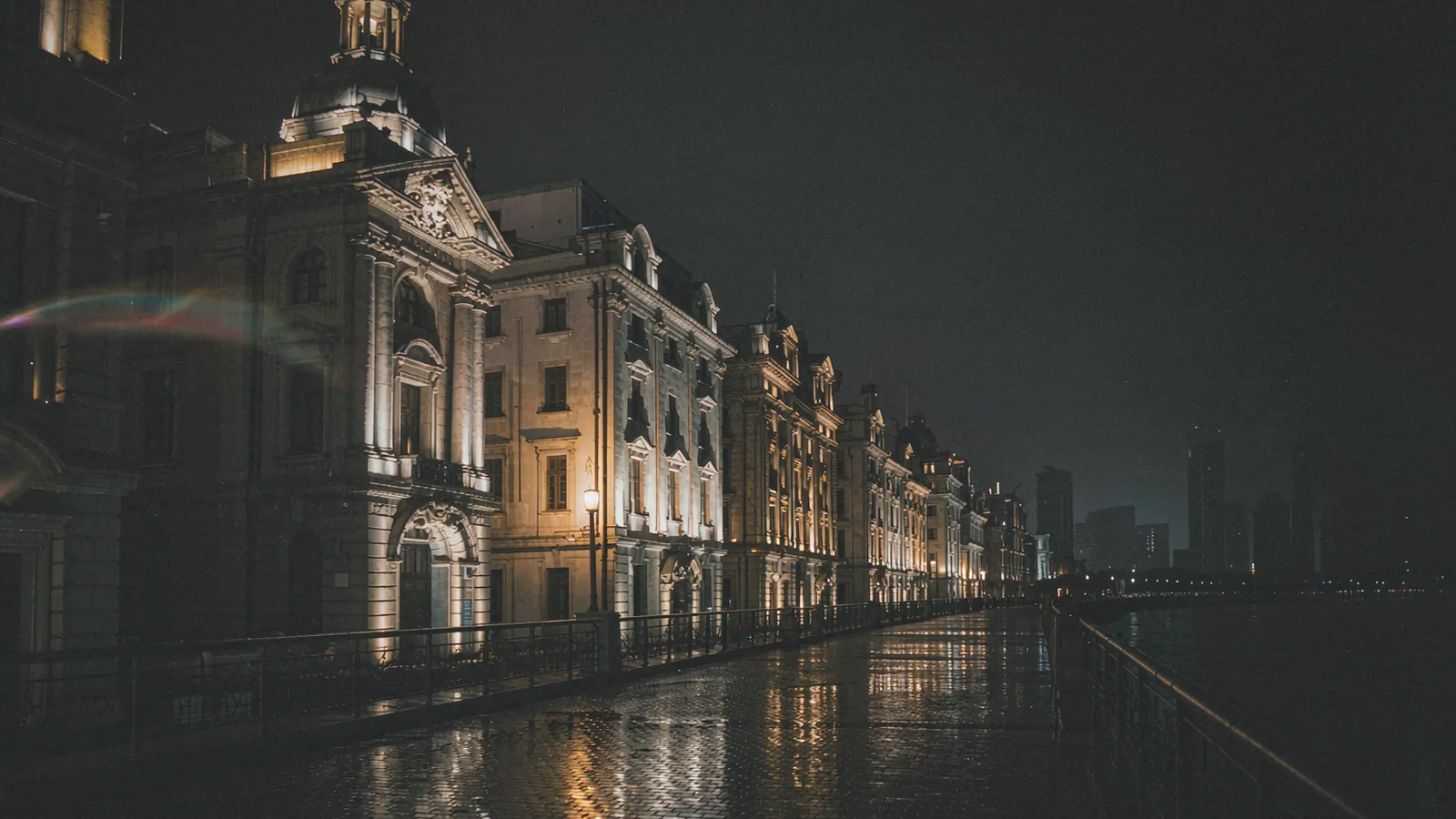
The Bund and the Huangpu river. A kilometre and a half of embankment and twenty-six historic buildings lit up every night. The best view of the Pudong skyline is taken from here, not from inside a tower. At dawn, between 6 and 7am, there are more people practising tai chi on the promenade than tourists, and the low light rakes across the stone. The lights go off around 10pm in summer.
Yuyuan Garden. The old city is four hundred years old, with carp ponds, teahouse pavilions and a sixteenth-century artificial rockery. It opens at 8:30am; being at the gate at 8:20am makes all the difference, because the garden is small. The bazaar around it is a trap of shops; you cross it without stopping. It is also the best place to step out of the walled quarter into the neighbourhood market just to the north, where xiaolongbao are eaten standing up.
The French Concession and the British Concession. Plane-lined streets in Xuhui and Jing’an: Wukang Road, Anfu Road, Ferguson Lane and the Wukang Building, shaped like a ship. This is the Shanghai of cafés and independent shops. We advise going early in the morning, before the queues to photograph the facades.
Tianzifang and Xintiandi. The first is a maze of low-house lanes turned into studios — go before 10am; Xintiandi is the polished equivalent, for a drink at the end of the afternoon.
The Shanghai Museum. Free, on People’s Square, with reservations made by us. It holds the most complete bronze collection in China and a ceramics hall you walk slowly. Closed on Mondays.
Pudong and the towers. Three observation decks to choose from: the Shanghai Tower on floor 118, the World Financial Center on 100 and Jin Mao on 88. The Shanghai Tower is the highest; Jin Mao has the best glass floor, over its atrium. We time the ascent to the hour when the sun starts dropping, so you get day and night on a single ticket.
How we run it
We always split Shanghai into two blocks: the historic city on one day, Pudong and the museums on another, with the concessions on foot in the late afternoon, at the hour when the light comes in sideways down the plane-tree streets.
We check visibility before buying tickets for any observation deck. In rain or fog it is money thrown away, and we tell the traveller so plainly — we would rather swap the viewpoint for an afternoon in a museum.
We book restaurants at least two days ahead for dinners outside the usual areas; for the neighbourhood xiaolongbao houses, we simply turn up and wait twenty minutes, queuing like everyone else.
How long to stay
Two nights settle Shanghai: Bund and old city one day, Pudong and museum the next, with the concessions on foot in the late afternoon. It is the standard fit in our twelve-day private tours.
Three nights allow an excursion: Suzhou and its classical gardens thirty minutes away by train, or Hangzhou and West Lake an hour away. They also allow a museum in the morning and Tianzifang before 10am, with slack in case it rains — and in June it rains.
Four nights make sense mainly for anyone travelling on business or coming for the food: only in Shanghai are there half a dozen restaurants that justify a trip on their own, and none of them fit into a day full of monuments.
If the trip is short, cut a Shanghai day before cutting a Beijing day. There are more irreplaceable things in Beijing.
When to go
March to May. 10 to 24 °C, gardens in bloom, the best time to be out on the street.
June. The plum rains arrive, the damp grey spell when it rains for weeks. It is the worst month of the year to visit.
July and August. 27 to 38 °C, humid, with occasional typhoons late in the summer. Seeing the city is possible because there is air conditioning everywhere.
September to November. 15 to 28 °C, dry clear skies, the best season. October has the most pleasant evenings for walking by the river.
December to February. 1 to 10 °C, damp, with no strong heating in the old buildings. It gets colder indoors than out. It is when Shanghai is cheapest.
Where to stay
Jing’an. Our pick for couples and for a second visit: modern, good restaurants, two metro lines to everywhere.
Huangpu, by the Bund. Classic, with skyline views from some rooms and within walking distance of the waterfront. The historic hotels here have art deco ballrooms worth visiting even if you are not sleeping there.
Xuhui, in the old concession. The best choice for anyone wanting tree-lined streets and cafés. Small boutique hotels in restored villas.
Pudong and Lujiazui. High-up views and offices; the streets empty at night. We recommend it only for short business trips.
What to eat
Shanghai eats better than Beijing and Xi’an. Start with shengjianbao, pan-fried buns crisped on the bottom with soup inside and sesame on top; then xiaolongbao, steamed buns whose broth you drink carefully — in autumn there is a version with crab roe found nowhere else in the country.
The house dish is hongshao rou, pork belly braised in a dark sweet sauce, ordered with plain white rice. There is also hairy crab from September to November, crispy eel, and sweet and sour mandarin fish.
Our usual addresses for clients: a counter-service shengjianbao house for breakfast, a Shanghai kitchen inside a dining room for lunch, and for dinner a booked table at a xiaolongbao house or at a restaurant doing refined regional cooking, chosen according to what the traveller wants to spend.
Getting there
Two airports. Pudong (PVG), international, with the maglev train to Longyang Road station in eight minutes at 430 km/h — the fastest commercial train in the world — or metro line 2. A taxi to Jing’an takes 50 to 70 minutes and costs about 200 yuan.
Hongqiao (SHA), mostly domestic flights, sits inside the city: metro or taxi in 30 minutes. Note that connecting from an international to a domestic flight via Beijing or Guangzhou can mean changing airports: Pudong–Hongqiao takes an hour on the metro.
By high-speed rail: Beijing–Shanghai in 4h18 to 6h, Suzhou in 30 minutes, Hangzhou in 1 hour. Shanghai Hongqiao station puts train and metro in the same building — on our arrivals the guide waits at the platform exit with your name written down, not at the station exit.
Where most agencies get it wrong here
Buying observation deck tickets days ahead. The Shanghai Tower costs about 180 yuan, and on a rainy day you look at a white wall. We check visibility on the morning itself and only then buy; when it is not worth it, we say so and propose an alternative.
Putting Shanghai at the end of the tour, on the departure day. Anyone flying at night spends their last afternoon shut inside a coach on the way to the airport. We always book the last night in the city, with dinner reserved.
Taking groups to Tianzifang in the afternoon. It is a maze of lanes with two doors: at 3pm you move shoulder to shoulder. Before 10am it is nearly empty and it becomes a different place.
Swapping the concessions for a sightseeing bus. The French Concession only makes sense on foot, in the shade of the plane trees; through tinted glass you see traffic. We walk Wukang, Anfu and Ferguson Lane, stopping for coffee.
Serving xiaolongbao as a group starter. Steamed buns go cold in three minutes and scald your tongue; they are eaten as a meal, in baskets, and you drink the broth with the spoon first. We book a table at a neighbourhood house and let one basket arrive at a time.
We run Shanghai privately at all times, two to six travellers per car, with no commercial stops on the programme.
Keep reading
How we organize it
01
We arrive early
We get into the monuments before the tour buses. The Wall at 7am, the Forbidden City at 8:30am.
02
A Portuguese-speaking guide
One guide from the first day to the last, in Portuguese. No handing you over to someone new in each city.
03
We handle the bookings
We take care of the named reservations that need a passport, including the ones that sell out in high season.
Frequently asked questions
How many days should you give Shanghai?
Two days cover the Bund, the old city and Pudong. Three allow an unhurried trip to Suzhou or Hangzhou, or a full day on the museums and the concessions on foot.
Is the Bund better in the morning or at night?
Both, for different reasons. At 6am the promenade is full of people doing tai chi and there are no tourists; after 7pm the historic buildings all light up at once. By 9pm there are crowds — we avoid that hour.
Is it worth going up the Shanghai Tower?
Only on a clear day. It stands 546 metres high and costs about 180 yuan; in fog or rain you see nothing. We check visibility on the morning itself and only then buy tickets; when it is clear, floor 118 is well worth the money.
Is Shanghai an expensive city?
It is the most expensive of the three big Chinese cities, especially for hotels and chef-driven restaurants. Even so, eating well on the street costs 30 to 60 yuan, and the metro rarely exceeds 8 yuan a ride.
Do you need Chinese to get around Shanghai?
No. It is the city where English works best in mainland China. On our private tours, though, having a guide still makes a difference once you leave the tourist areas.
Tours that include Shanghai
Talk to the people who run it
Want Shanghai in 2 to 3 nights, or a different way round?
Tell us how many you are, when you want to go, and what cannot be left out. We shape the itinerary from there.
Chat on WhatsAppReplies in English · no obligation