Tours
China in Winter
Eight days between Beijing and Harbin, when the country turns white and the cities empty out.
At a glance
- Days
- 8
- Nights
- 7
- Who it suits
- Anyone who wants snow · December to February · couples and photographers
- Price per person
- US$ 3.200 a 4.200
Day by day
Eight days between Beijing and Harbin, in the month when northern China is white, the monuments stand almost empty and the low golden light lasts until four in the afternoon. It is the tour we recommend to anyone who has already been to China in summer and wants to see another country.
Why in winter
The difference is not the cold, it is the number of people. In January, the Forbidden City at 8:30 has more staff than visitors, and you can stand in whole courtyards with your group alone; in August the same hall requires you to walk with your elbows tucked in. On top of that there is a shallow golden light which in the north never climbs more than 15 degrees above the horizon, and roofs under snow, which throw the light back up and open out the shadows.
There are trade-offs, and it is honest to state them. The days are short: in Harbin it goes dark before 16:30 and you have to use the whole morning. In Beijing temperatures run between minus 8 and 4 degrees; in Harbin, between minus 15 and minus 30, with a lower wind chill when it blows. Between the two extremes, the programme builds in stops in heated spaces every two hours and keeps the vehicle at the door at all times.
A trip to China in January also has its own logistics: snow on the roads, domestic flights subject to delay, and equipment that cannot be bought at the last minute. We send the clothing list three weeks before departure and, for anyone who does not want to invest in a coat they will wear once, we arrange the rental of a thermal coat, boots and gloves locally.
How we organise it
This is a private tour, assembled from two people, with exclusive guide and car and no scheduled shopping — which at minus 20 degrees is more than a matter of principle: it lets us cut a bad day short and extend a good one without depending on a group. We confirm the exact dates of the International Ice and Snow Festival before accepting each booking, because the festival opens and closes according to the winter and some years are atypical.
As a travel agency for China with an operation on the ground, we follow the weather forecast in the days before each stage and reorder the programme when there is an advantage in it: the Wall on the first clear day, Harbin on the night the site opens, Beijing on the days when the monuments are emptiest.
What the price includes
- English-speaking guide in Beijing, Harbin and Shanghai
- Private driver and vehicle with permanent heating
- Seven nights in four-star hotels with strong heating, five of them in the north
- High-speed train Beijing–Harbin in first class and the Harbin–Shanghai flight
- Thermal equipment list, hand warmers and assistance with cold-weather clothing rental
- Entrance to every monument, including the International Ice and Snow Festival, and the Beijing–Harbin train ticket
- Six meals besides breakfast and permanent phone support in English
- Reordering of the programme according to the weather forecast, at no extra cost
- Assistance with renting and checking cold-weather equipment on arrival
What the price does not include
- International flights to and from China
- Chinese tourist visa and consular fees
- Rental of thermal coat, boots and gloves in Harbin (around 200 to 300 yuan a day)
- Alcoholic drinks with meals and tips for guide and driver
- Travel insurance and personal expenses
01Day 1
Arrival in Beijing
Afternoon and evening. Pick-up at the airport and transfer to Dongcheng. Handover of the winter kit — hand warmers, lip balm, inner gloves — and a check of what is still missing. Meal. Light noodle soup dinner at a restaurant near the hotel.
The first night serves two purposes: sleeping early and getting the equipment right. We go through with the guide what is missing — inner gloves, a hat that covers the ears, wool socks, thermal insoles — and settle what to rent in Harbin, where hiring coat, boots and gloves costs around 200 to 300 yuan a day and avoids buying something that will be of no use anywhere else.
Meals: dinner.
02Day 2
The Wall under snow
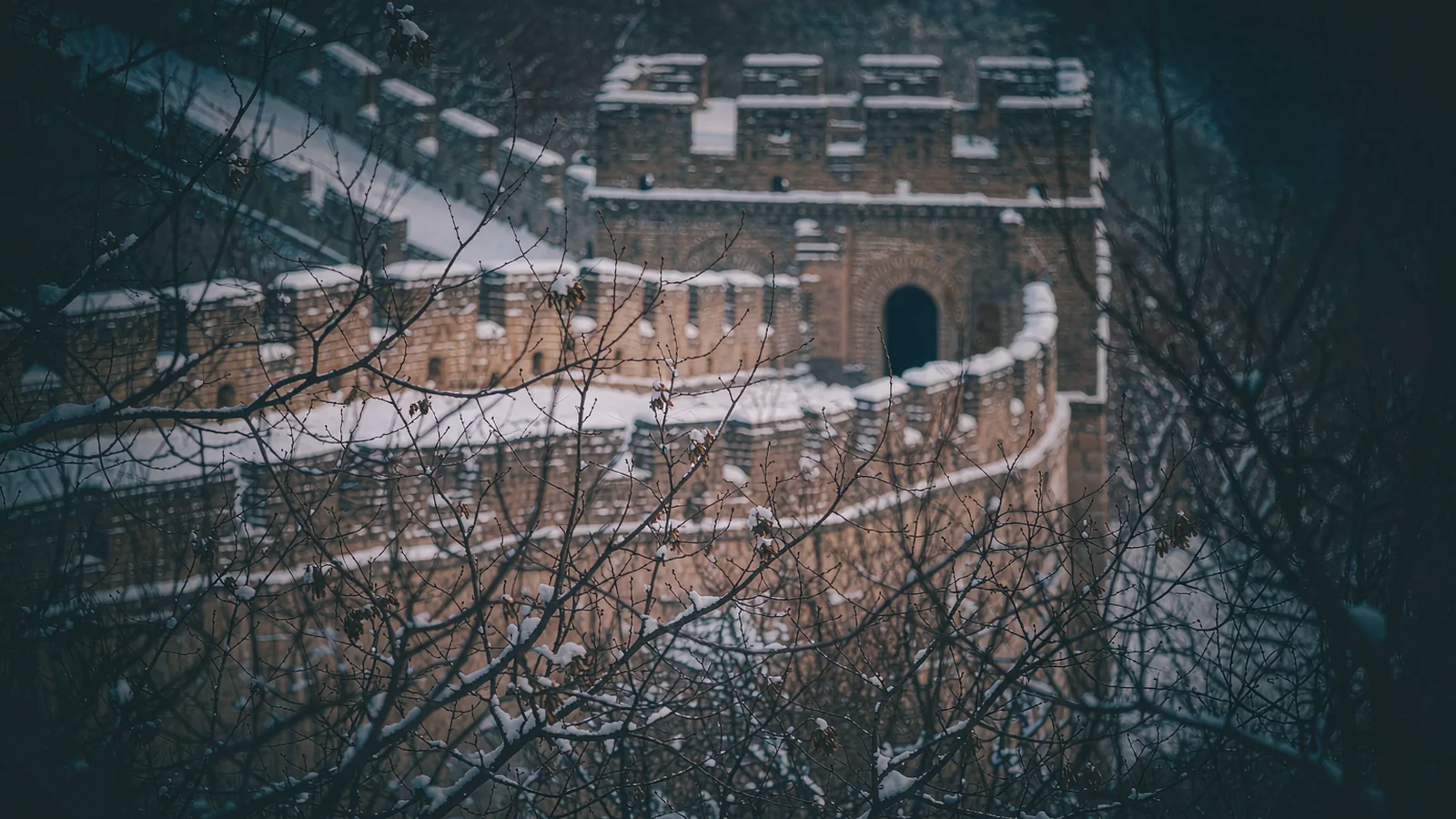
Morning. Departure at 6:30 for Mutianyu. By 7:30 the Wall is white, empty of visitors, with the valleys full of fog. The cold hurts less because of the effort of the climb. Afternoon. Hot farmhouse lunch and back to Beijing.
You climb for less time than in May, and the effort of the climb makes up for the cold — the most common mistake is wearing too much, sweating on the first slope and then freezing on the way down. You wear layers and take them off one at a time. Gloves are compulsory: without them you cannot hold the stone parapet for more than twenty seconds. Evening. Peking duck dinner, with the reservation made by us.
Meals: breakfast and dinner.
03Day 3
Forbidden City and hutongs
Morning. Entry to the Forbidden City at 8:30. In January there are no crowds: you can be in entire courtyards with only your group and the staff.
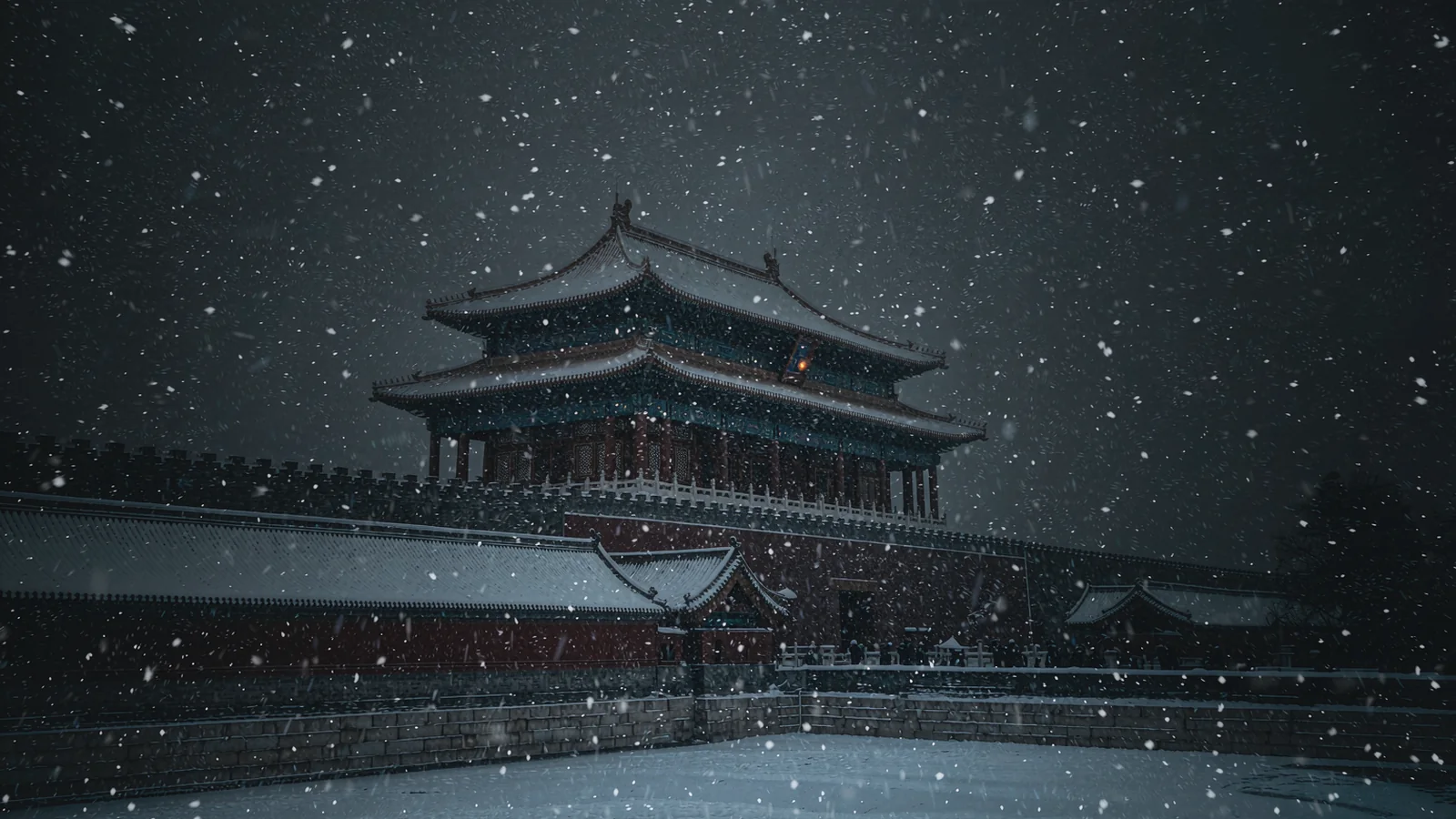
The double eaves of one of the Forbidden City's corner towers under snow. In January the cold stone and the yellow roof give the contrast you look for all the rest of the year. The winter visit is shorter than the summer one, and for good reason: after two hours outdoors with no heated shelter along the way, the will to carry on drops sharply. The imperial axis is programmed from one end to the other and the side courtyards are left for a faster second pass. Afternoon. Jingshan Park for the view over the snowed roofs, late lunch of zhajiangmian, and a walk through the hutongs at the end of the day. Evening. Dinner at leisure. We suggest the Niujie district, where skewers taste better in the cold.
Meals: breakfast and lunch.
04Day 4
Beijing to Harbin
Morning. Temple of Heaven at 8am. Winter is when the contrast between the cold stone and the locals practising tai chi in thick coats shows best. Afternoon. Beijing–Harbin train, 4h30 to 7h in first class, crossing the Manchurian plain with snow already on it.
It is one of the finest train journeys in the country and it is done in a reserved seat, with strong heating on board and power sockets. The thickest clothing belongs in hand luggage, not in the boot of the car: on arrival in Harbin, anything left inside the vehicle goes cold in ten minutes. Evening. Arrival, check in near Central Street, and a first short fifteen-minute walk to test the equipment.
Meals: breakfast and dinner.
05Day 5
Harbin, Russian architecture
Morning. Central Street in the morning: the 1898 cobblestones, Russian bakeries and ice cream sold on the street at minus 20 degrees. St Sophia Cathedral. Afternoon. Stalin Park and the Provincial Museum, both heated and almost without visitors. Lunch of guo bao rou, the sweet and sour fried pork of Russian origin.
Harbin owes its name and its plan to the Russians who built the Trans-Manchurian Railway at the end of the nineteenth century, and the city has never lost that inheritance: bakeries selling rye bread, ice cream sold on the street at minus 20 degrees, and yellow brick buildings that look as if they came from another latitude. It is also here that you eat better than in any other city in the north. Evening. Dinner of pork dumplings in cabbage broth, and preparation for the following night.
Meals: breakfast and lunch.
06Day 6
The Ice Festival
Morning. Free morning to sort out the equipment and rest. Technical briefing on cold-weather photography: batteries kept against the body, fast lens changes inside a closed bag, condensation to be avoided. Afternoon. Entry to the International Ice and Snow Festival site at 16:30, when the lights come on. Full-size sculptures of palaces and temples, lit from within.
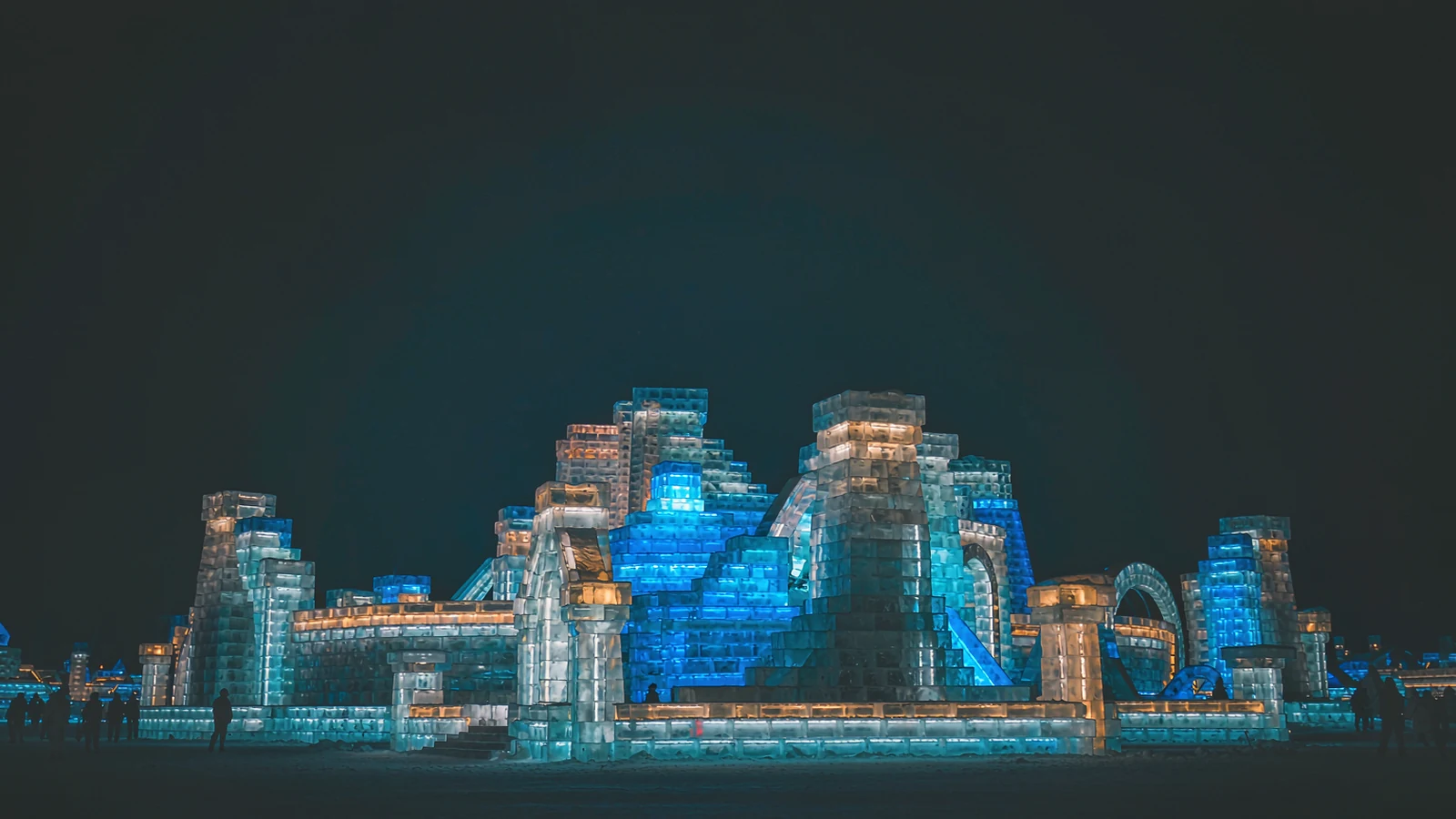
Night at the International Ice and Snow Festival. The blocks are cut from the Songhua River and have lights inside them, which gives the site the blue and orange you cannot get by day. The site opens late in the afternoon on purpose: the sculptures are made from blocks of ice taken from the Songhua River, with light tubes running through them, and only after dusk do they acquire the relief that justifies the trip. The first two or three hours after opening are the best, because the cold has not yet made itself felt and the trodden snow has not yet turned to a mirror.
Evening. Hot dinner at a restaurant beside the site. For anyone who wants it, a second entry to the festival at their own expense.
Meals: breakfast and dinner.
07Day 7
Flight to Shanghai
Morning. One last pass along Central Street by day, to photograph it without crowds. Afternoon. Harbin–Shanghai flight, about three hours. Check in at Jing’an and free time.
The move from Harbin to Shanghai is the thermal contrast of the tour: in a few hours you go from minus 20 degrees to a humid city of mild winter, where the plane trees still have leaves on them. It also serves as compensation for anyone who has spent six days sleeping in a coat indoors.
Evening. Farewell dinner of Shanghai cooking: xiaolongbao and braised pork belly. A guaranteed thermal contrast with the previous day.
Meals: breakfast and dinner.
08Day 8
Departure from Shanghai
Morning. The Bund at dawn, a last walk and final shopping. Private transfer to Pudong airport three hours before the flight.
Anyone with more days can extend to Hangzhou and Suzhou, where winter is short and the gardens are clear of people. To come back within the same year, this tour combines well with a route through the south, made between March and April.
Meals: breakfast.
Three things you will not repeat
01
The Harbin Ice Festival at night, lit from inside
02
The Wall at Mutianyu under snow, with no visitors
03
The Forbidden City thinly attended, in winter light
Price
US$ 3.200 a 4.200
Per person · 8 days · 7 nights
Land portion in China, double room, excluding international flights. From 2 travellers.
What's included
- Land transport in China: high-speed rail and domestic flights as listed
- Portuguese-speaking guide from the first day to the last
- 4-star hotels, double room
- Entry tickets to the monuments listed in the itinerary
- Daily breakfast
What's not included
- International flights to and from China
- Visa and consular fees
- Meals not listed in the itinerary
- Tips and personal expenses
Frequently asked questions
How cold is it?
In Harbin, between minus 15 and minus 30 degrees, with a lower wind chill when it blows. In Beijing, between minus 8 and 4 degrees. We send a thermal equipment list three weeks before departure and help arrange local rental of coat, gloves and boots for anyone who would rather not buy.
How physically demanding is it?
Moderate, made harder by the cold. You walk less than at other times of year and stop in heated spaces every two hours. There is no trekking and no altitude. Anyone with cardiac or respiratory conditions should speak to a doctor before booking destinations at minus 20 degrees.
Is there a single room supplement?
Yes, between US$ 420 and US$ 620 depending on season. Every hotel on this route has strong heating, which in Harbin is not a luxury but a requirement. Anyone travelling alone receives a closed quote before booking.
Do I need a visa for this tour?
Yes, a tourist visa for mainland China, applied for at least a month in advance. We handle the invitation letter and the hotel and domestic flight bookings the application requires. There is no visa waiver in Beijing or Harbin for ordinary stays.
What if the festival has not opened yet, or has already closed?
We confirm the exact dates of the Ice Festival before confirming any booking. If the year has atypical dates, we warn you before taking payment and propose alternative dates or a switch to another tour, with no penalty.
Can the dates be changed or postponed?
Yes. No cost up to 30 days before; between 30 and 15 days we retain expenses already committed; under 15 days the suppliers' conditions apply. Postponing to the following winter is always possible, transferring what has been paid.
Cities on this tour
This tour is a starting point
It is not a fixed package.
We can add days, swap cities or drop stages. Tell us what you want and what cannot be left out.
Chat on WhatsAppReplies in English · no obligation