Regions
Zhangjiajie and Fenghuang
The sandstone pillars of Wulingyuan and the old town of Fenghuang, in northwest Hunan. How many days, how to link the two, and when to go.
At a glance
- Recommended days
- 8 days
- Cities to combine
- Zhangjiajie · Guilin and Yangshuo · Shanghai
- How you travel
- Private · English-speaking guide · no shop stops
- Updated
- October 18, 2026
There are two reasons for coming to northwest Hunan, and they are very different: a geological landscape that exists nowhere else inhabited, and a wooden old town over a river. Zhangjiajie and Fenghuang form the most coherent route in inland China — three hours of travel separate a park of sandstone pillars from a town that has kept its village structure — and it is one of the few regional pairings where the two halves complete each other rather than repeat each other.
Zhangjiajie: the pillars
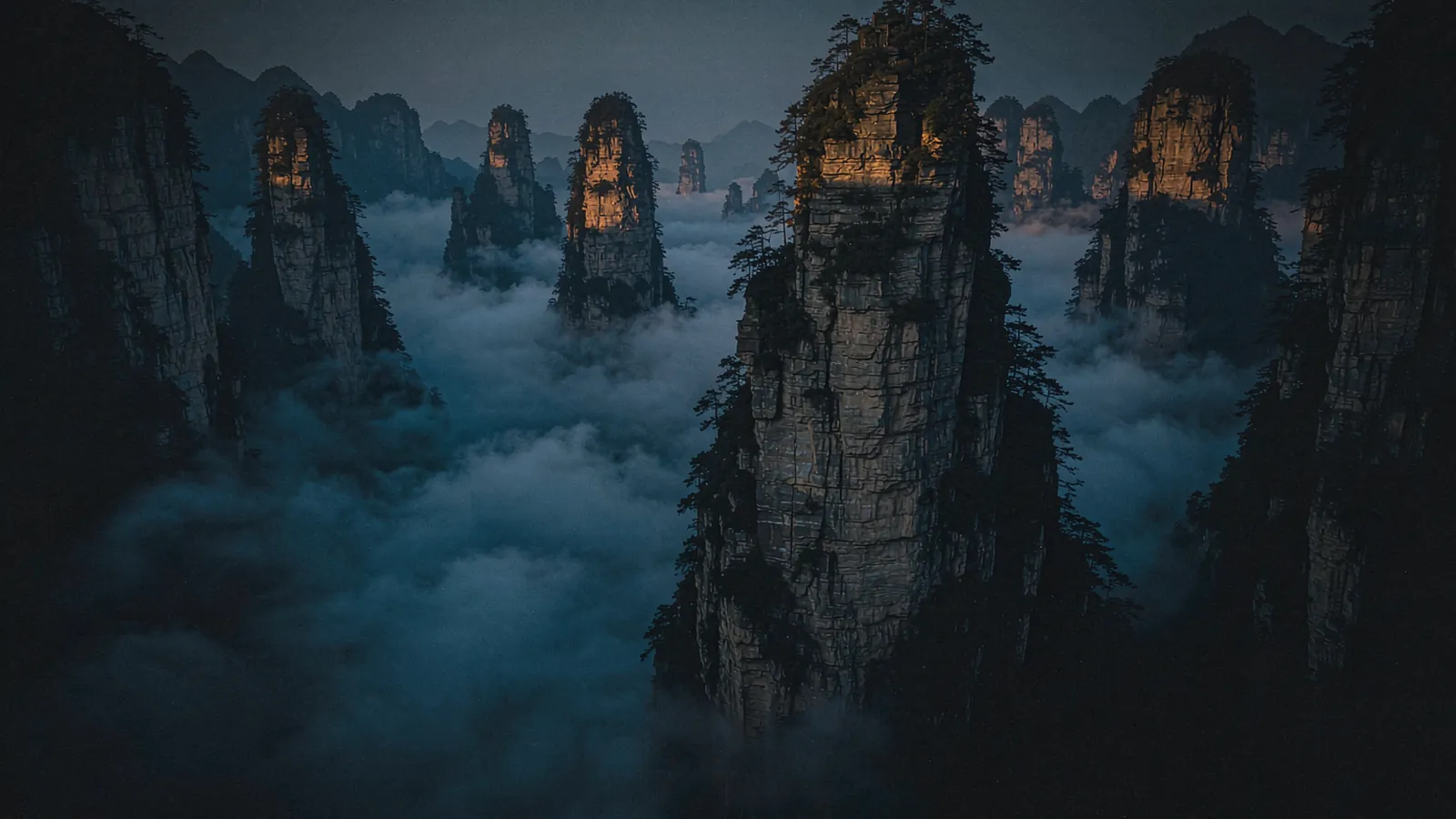
Wulingyuan, listed by UNESCO in 1992, is a field of more than three thousand quartzite sandstone pillars, some over 300 metres tall, raised by erosion over millions of years. It is not the limestone karst of Guilin: it is sandstone, which explains the vertical edges and the flat tops, almost cut with a knife.
The park divides into zones that need more than one day:
Yuanjiajie, with the pillars that inspired the floating mountains of the film Avatar — one column was actually renamed after the film. It has a boardwalk around the top, and it is where the photograph everyone knows is taken.
Tianzi Shan, the highest zone and the best seen from above, with viewpoints over a sea of towers. The name comes from a Tujia chieftain of the fourteenth century who rebelled against the Ming dynasty.
Suoxi valley and the Yellow Dragon cave, with underground chambers and a river navigable inside.
The Hundred Dragons elevator, a glass box set into the cliff that climbs more than 300 metres in under two minutes. It solves the ascent and is, in itself, one of the things you tell people about afterwards.
Tianmen Mountain and the glass bridge
Outside the main park, two places that deserve a day each, or at least a day between them.
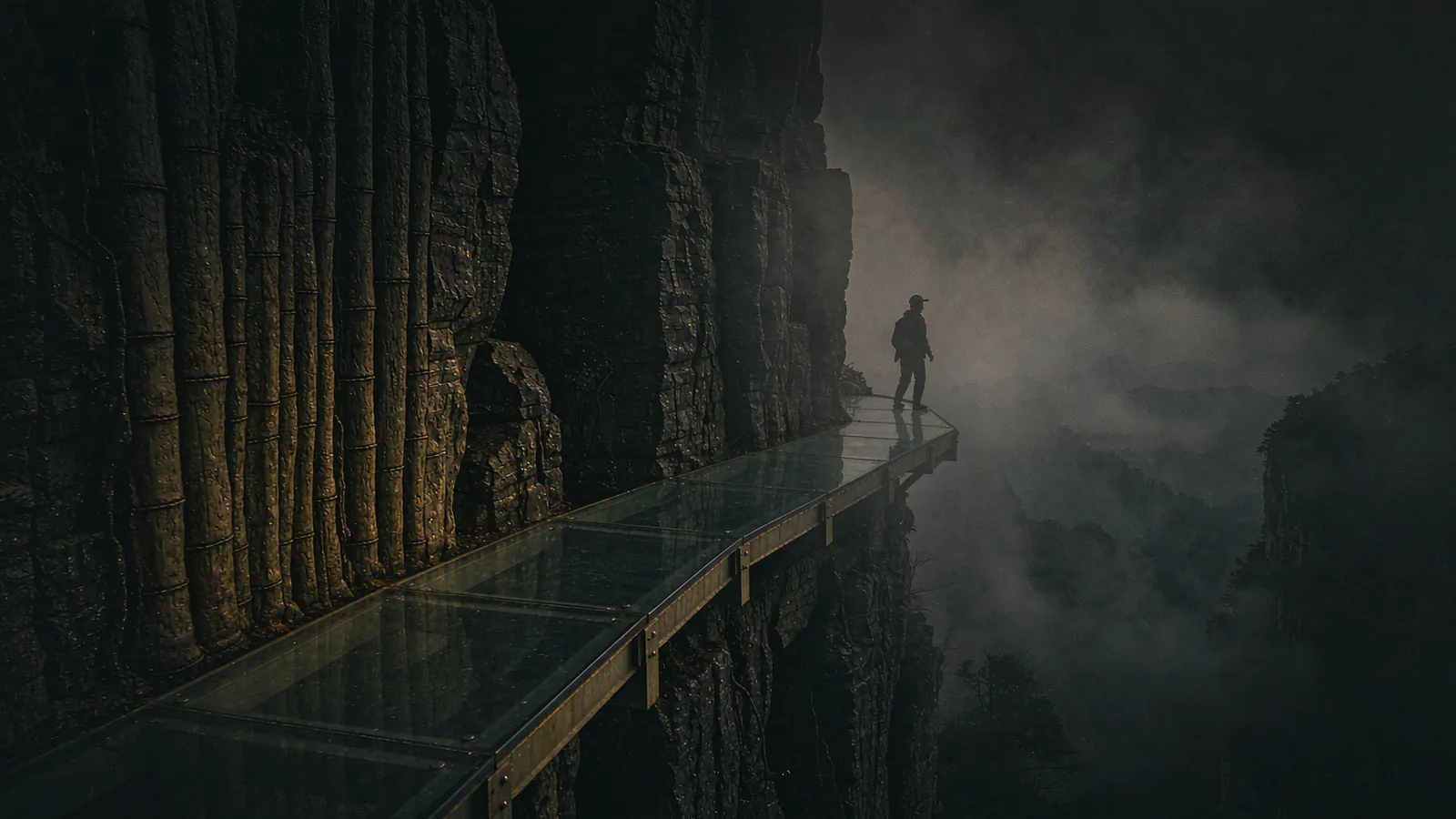
Of the two, Tianmen Mountain has a natural arch opened through the rock — the “gate of heaven” that gives it its name — a road of 99 bends climbing the slope, and a long cable car that reaches the summit. It has glass walkways against the cliff, which is not for everyone, and a view over the town that solves the problem of not being able to photograph the park from a distance.
The glass bridge over the Zhangjiajie canyon crosses a gorge several hundred metres up, on transparent flooring. It is a recent attraction, heavily in demand and with entry limits: it is booked in advance, and there are days when it closes for maintenance or wind.
Fenghuang: the phoenix town
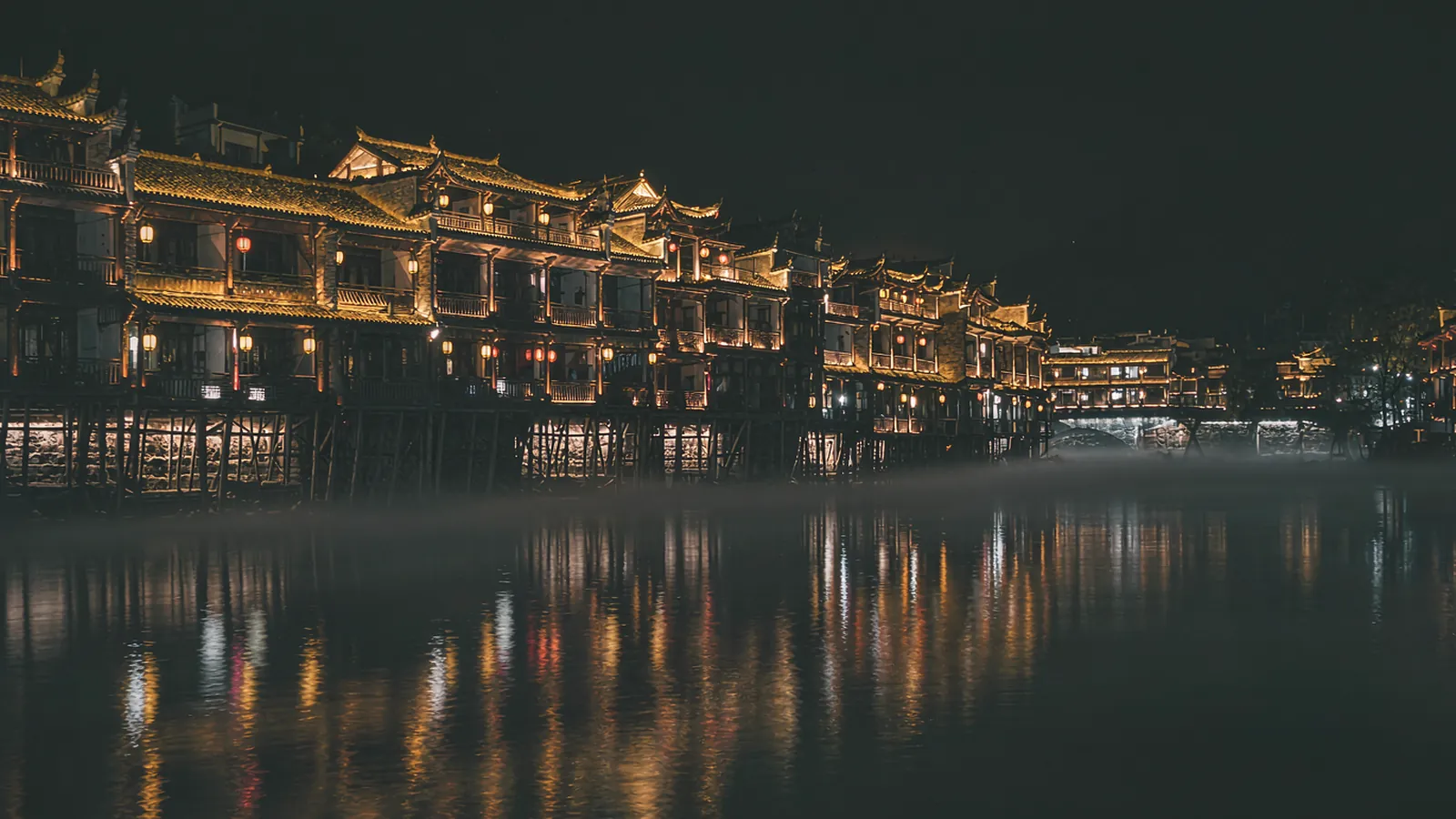
About two hours to the southwest, already in the Xiangxi autonomous prefecture, lies Fenghuang. It is one of the best-preserved old towns in China, inhabited mainly by Miao and Tujia communities, built over the Tuo river with stilt houses — the diaojiaolou — pressed against the water.
What you do there is simple and it is everything: cross the rainbow bridge, walk the flagstoned lanes at dawn, when people are still washing clothes in the river, look at the black tile roofs and tilted eaves, and take a boat out at dusk with the lanterns lit. By day it is a beautiful town; at night it is a staged town, and very crowded. Sleeping there makes the difference: anyone arriving in the morning and leaving in the afternoon gets the worse version.
Around it there are Miao villages and the Southern Great Wall — a Ming wall different from the one in the north, lower and built for internal containment, which almost nobody visits. It is one of the most interesting detours in the region.
Furong, the stop between the two
Halfway between Zhangjiajie and Fenghuang lies Furong, a village built over a waterfall that falls straight into the river. It is two thousand years old, has been a film location, and is much smaller than Fenghuang. It can be done over a day with a night there, or as a three-hour stop on the way, and it is where you eat best in the whole region.
It is also the stop that avoids a continuous day of transfer between the two ends of the route.
Where to sleep
In Zhangjiajie, two options: the town, with standard hotels and restaurants, half an hour from the main gate of the park; or the guesthouses at the entrance to Wulingyuan, simpler but ten minutes from the cable cars. For anyone wanting to start early — and here, starting early is the difference between an empty viewpoint and a queue — you sleep inside the park.
In Fenghuang, guesthouses over the Tuo river, preferably off the main axis, because the central streets have music until late and the noise reflects off the water. The room with a balcony over the river costs more and is worth every cent in the first two hours of the day.
In Furong, supply is small and it is booked in advance. It is the stage where you choose by availability rather than by comfort.
What you eat in Hunan
Hunan cooking — xiang cai — is one of the eight great regional traditions of China and the hottest of all that you meet on a standard itinerary. Hot with fresh and fermented chilli, not sweet: fried stinky tofu, river shrimp with chilli, steamed pork ribs with black pepper, Xiangxi smoked bacon, and bowls of rice noodles for breakfast, which in Hunan are eaten at any hour.
For anyone who cannot take the heat, a word of warning: you ask for bu la (“without chilli”) and even then it is best to pick grilled or steamed dishes. It is one reason to travel with a guide rather than independently.
How many days
Five days cover the essentials: two in Wulingyuan, one on Tianmen Mountain, two in Fenghuang. You come away feeling you ran through the park.
Seven to eight days is the recommended programme. Three nights in Wulingyuan, one on Tianmen Mountain, one in Furong, two in Fenghuang. It is the pace at which you can repeat a viewpoint in the morning because the day before it was fogged in, which happens here regularly.
Ten days add the Miao villages, the southern wall and a descent as far as Guilin, whose hills are the nearest alternative and, geologically, the complementary opposite: rounded karst instead of angular sandstone.
The mist, which is half the landscape
Wulingyuan has mist on more than half the days of the year, and that is why the same viewpoint produces three different images on three consecutive mornings. It is not a meteorological defect: it is the reason the pillars appear to float in photographs. The practical consequence is that you plan two park days instead of one, and choose the order of the zones according to the forecast — Tianzi Shan first on a clear day, the valleys on a fogged-in one, because inside a valley the mist improves the scene rather than ruining it.
When to go
April to June. Living green, waterfalls running, mild temperatures. The best time for covering a lot of ground.
July and August. Humid heat and domestic high season, with queues at the elevators and cable cars. It can be done, but you start early.
September to November. Our preference: dry air, good light, and the slopes beginning to change colour.
December to March. Cold, sometimes frost, and days when the fog never lifts. But when it does lift — and it does — the pillars appear above a sea of clouds, which is the best image the region gives.
We avoid the two weeks of Chinese New Year and the first week of October.
How it is organised
You reach Zhangjiajie by air, or by high-speed train from Changsha in about three hours. Fenghuang has its own station on the new line, which made the link between the two much shorter than it used to be. Within the region a private car with a driver is always used: the roads are mountain roads, and scheduled coach timetables are no use to anyone wanting to be at a viewpoint at seven in the morning.
We book the glass bridge and the Tianmen Mountain cable car in advance, because both have daily limits and closures depending on conditions. The Hundred Dragons elevator is booked too, and it is worth deciding the order of the zones before entering the park, because Wulingyuan has several gates and choosing the wrong one costs an hour.
For photography, the region is one of the two axes of Photographic China, precisely because of the mist: the same viewpoint gives three different images on three consecutive days. For couples it is also one of the variants of Hidden China Honeymoon.
We organise Zhangjiajie and Fenghuang privately at all times: two to six travellers, a private guide, and no stops at silver shops or staged “cultural villages”, which are an industry in this region.
Tours that pass through Zhangjiajie and Fenghuang
Cities to combine
Frequently asked questions
How many days do you need for Zhangjiajie and Fenghuang?
Seven to eight days handle both places without hurrying: three to four in Wulingyuan, one on Tianmen Mountain, two in Fenghuang and one night in Furong. Five days cover the essentials, but they force a choice between the park and the old town.
Is Zhangjiajie physically demanding?
The park has elevators and cable cars, but there are long stairways and downhill stretches walked on foot that punish the knees. Trainers with grippy soles and a walking stick are advisable. Anyone with reduced mobility can reach the main viewpoints, but not the valleys.
What is the best time for Wulingyuan?
April to June and September to November. In summer there is humid heat and queues; in winter the cold is dry and there are days of fog that hide everything, but also frost days when the pillars appear clean above the clouds, and those are the best of the year.
Is Fenghuang just a staged tourist town?
It has mass domestic tourism, and you notice it at night on the main streets. Even so, it is a town inhabited by Miao and Tujia communities, with stilt houses over the Tuo river, and it is worth it above all early in the morning, before the streets fill. Sleeping one night there changes the experience.
How do you travel between Zhangjiajie and Fenghuang?
By high-speed train or private car, in about two hours. Furong lies halfway, the village built over a waterfall, which is the natural stop between the two. The local routes are always driven by someone who knows the mountain road.
Talk to the people who run it
Want Zhangjiajie and Fenghuang in 8 days, or a different way round?
Tell us how many you are, when you want to go, and what cannot be left out. We shape the itinerary from there.
Chat on WhatsAppReplies in English · no obligation