Regions
The Silk Road
From Xi'an to Dunhuang, the Gansu corridor between desert, Buddhist caves and rammed-earth walls. Nine to twelve days overland, without hurrying.
At a glance
- Recommended days
- 12 days
- Cities to combine
- Xi'an · Yunnan · Lhasa
- How you travel
- Private · English-speaking guide · no shop stops
- Updated
- October 18, 2026
The Silk Road was never a road. It was a bundle of paths linking China to the Mediterranean for more than a thousand years, with no fixed route: it shifted according to wars, wells and the taxes of each period. Travel along the Silk Road today means covering the Chinese stretch of that bundle, between Xi’an and Dunhuang, along which passed camel caravans, Buddhist monks, tea merchants and armies. It is also the part of China that least resembles postcard China: instead of pagodas and skyscrapers, desert, rammed-earth walls, caves cut into cliffs, and cities that exist because there was water.
What the Silk Road is, after all
The name was invented in the nineteenth century by a German geographer, but the thing itself is older and messier. There was not one route: there were several, and the most used one changed dozens of times. The stretch visited today is the Hexi corridor, a narrow band of fertile land in Gansu province, squeezed between the Qilian mountains to the south and the desert to the north. For centuries it was the only possible way out of China overland without crossing 5,000-metre mountains.
That is why the region carries the density of history it does: everything passed through there. Silk went out; Roman glass came in, along with the Ferghana horse, Buddhism, Islam, gunpowder and pepper. Each city in the corridor was at some point a frontier with a customs post, and each one keeps a remnant of that function — a wall, a fort, a market still selling spices from places three thousand kilometres away.
Xi’an, the eastern end
The whole crossing starts in Xi’an, the ancient Chang’an, capital of dynasties for more than a thousand years and one of the largest cities in the world in the eighth century. It lies east of the corridor, in the Wei river valley, and it is where silk was made and gathered before travelling west.
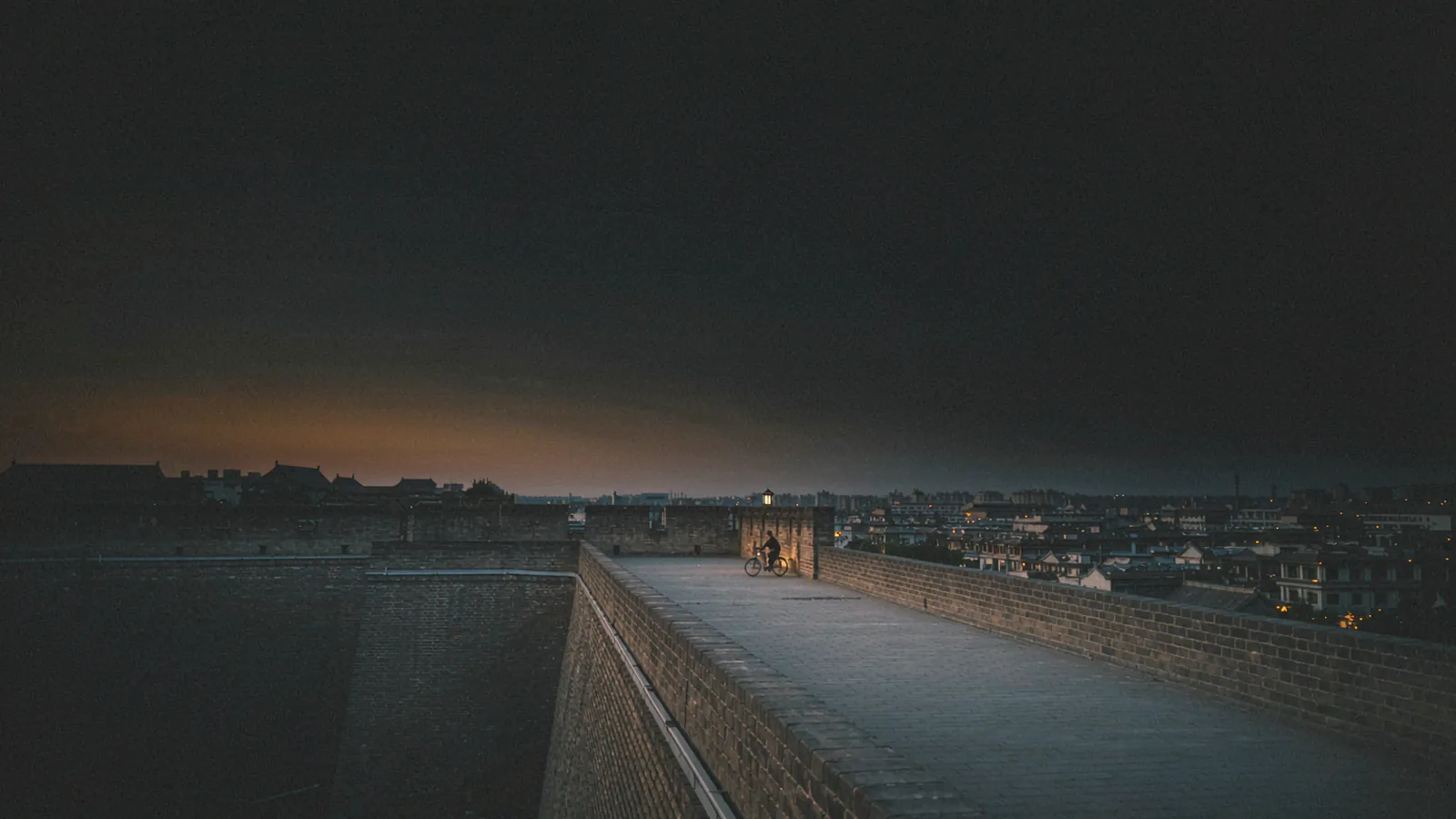
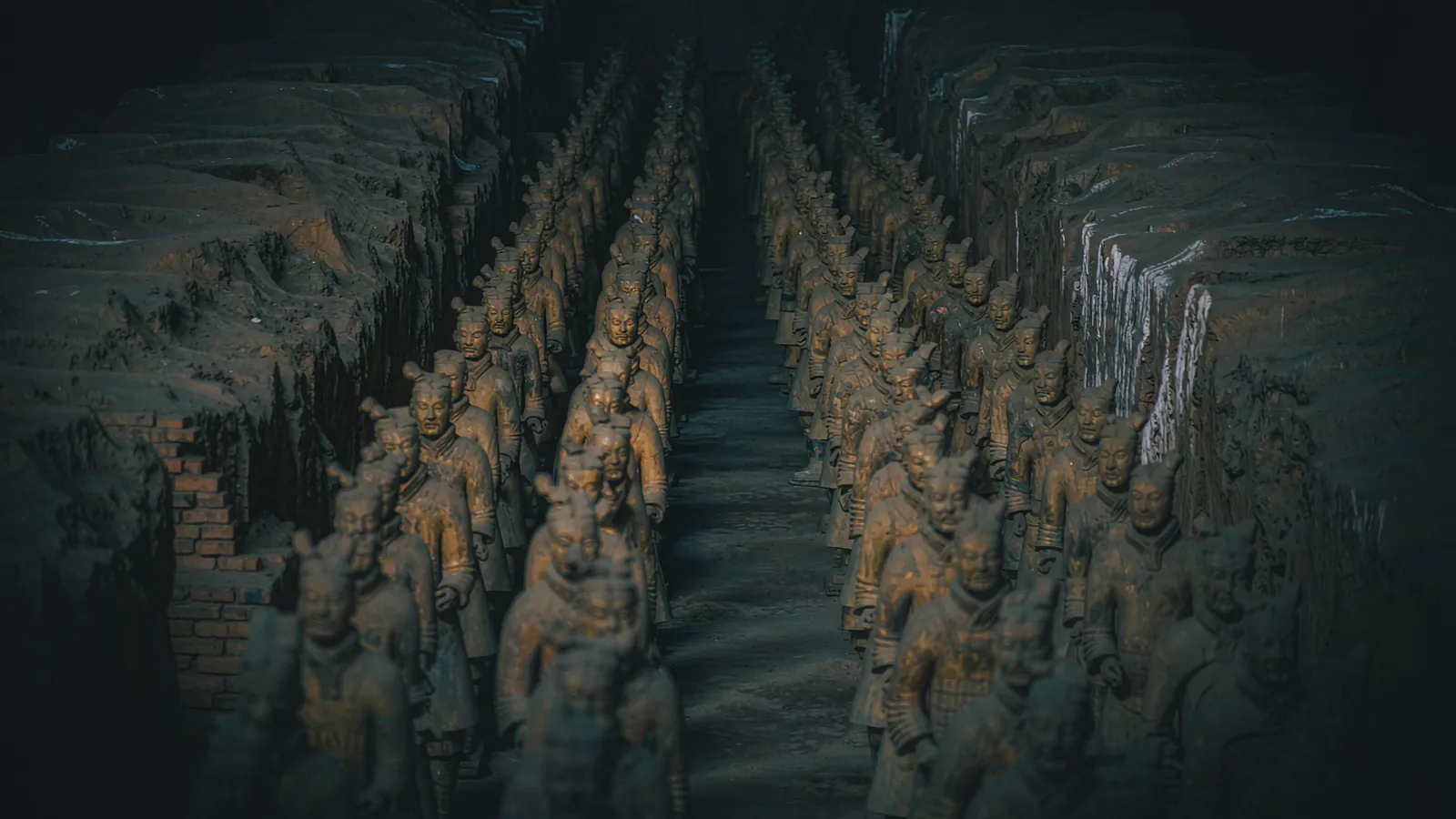
It is worth two to three nights. The Ming city wall, some 14 kilometres round and intact, can be cycled along the top and gives you the measure of the old city. The Terracotta Army, discovered in 1974 by peasants digging a well, is an hour away and deserves a full half day with a guide: without explanation it is a pit with statues. The Muslim quarter, with its Great Mosque built with a Chinese roof and a pagoda minaret, is living proof that the corridor brought people and not only goods — the Hui community has been in Xi’an for over a thousand years.
For anyone coming to China for the first time, Xi’an fits without effort into Essential China, which combines Beijing and Shanghai in a ten-day route. The Silk Road is the natural extension for a second trip.
The Hexi corridor, stage by stage
Between Xi’an and Dunhuang there are around 1,700 kilometres, and the temptation is to do them in one go. It should not be done. Every stop has a reason for existing.
Lanzhou, the capital of Gansu, is above all a rail junction and the point where the Yellow River crosses the city. It is worth it for the provincial museum and the night market; you sleep one night and move on.
Wuwei was the capital of an independent kingdom in the centuries of fragmentation and keeps the best museum in the corridor, with the bronze galloping horse that is the symbol of the province.
Zhangye is the stop that surprises most. To the north lie the Danxia mountains, layers of red, ochre and grey sandstone folded by tectonics and then carved by erosion, which at sunset look painted. Inside the city, the Dafo temple keeps a reclining Buddha of thirty-some metres, in wood and clay over a wooden frame, filling an entire hall.
Jiayuguan is the western end of the Great Wall in the versions that survive to our day: a rammed-earth fort with watchtowers, raised in the fourteenth century, surrounded by desert on every side. Here the wall climbs no hills and cuts through no valleys — it is a low line of beaten earth in the middle of nothing, and for that reason it is more striking than the restored stretches near Beijing. It is the place where you understand that the wall was a fiscal frontier before it was a defence.
Dunhuang and the Mogao caves
Dunhuang is the end of the classic line and the reason almost everybody makes this trip. It was the last oasis before the Taklamakan desert, and for centuries it was the meeting point of caravans that went round the desert to the north or to the south.
The Mogao caves are the most important set of Buddhist art in China: close to 500 grottos cut into the cliff over a thousand years, with murals and painted sculpture, listed by UNESCO. The standard visit opens a limited number of caves; the special caves require their own reservation and are not always available. It is one of the reasons this route is organised in advance rather than by turning up at the gate.
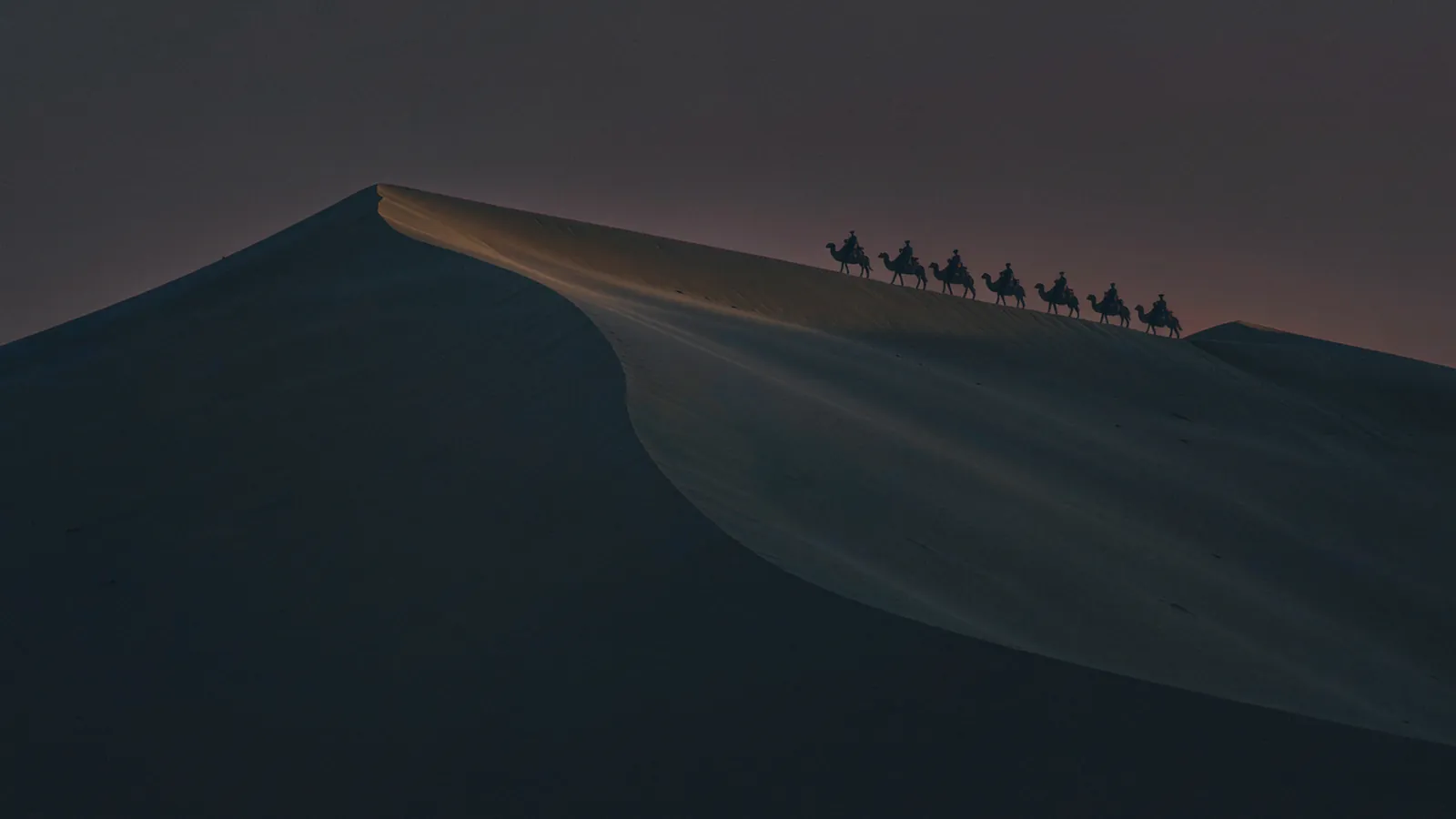
Ten minutes away lies Mingsha Shan, the mountain of singing sands, and Crescent Lake, a half-moon oasis wedged between dunes for at least two thousand years. You climb the camel dune or walk up late in the afternoon, when the sand cools and the light grazes the ridges.
For anyone combining photography with the route, this is the strongest stretch in the country at this latitude, and it is one of the reasons the region features in Photographic China.
The Tibetan detour via Xiahe
With twelve days instead of nine, you add a detour south to Xiahe, already in the Tibetan prefecture of Gannan. Labrang monastery stands there, one of the six great monasteries of the Gelug school and one of the few monastic communities that came through the twentieth century without being destroyed. At 2,900 metres it is the first gain in altitude on the route and it serves as preparation for anyone continuing to the plateau — from here to Lhasa or to Shangri-La in Yunnan, the logic is the same: climb in stages.
It is also the stretch that makes the difference between “I did the Silk Road” and “I understood the Silk Road”. Without this detour the corridor is a succession of monuments; with it, it becomes a frontier region where three worlds — Chinese, Tibetan and Muslim — press against each other.
Anyone with twenty days joins all of this to the southwest on the Grand Crossing along the Silk Road, which comes down from Xi’an to Yunnan and then climbs to Tibet.
How many days
Seven days is the absolute minimum: Xi’an, Zhangye, Jiayuguan and Dunhuang, with two nights in Xi’an and one at each intermediate stop. It works, but it forces two full days on the road.
Nine to ten days is the recommended programme. It allows two nights in Xi’an, one in Lanzhou or Wuwei, two in Zhangye, one in Jiayuguan and two in Dunhuang. It is the pace at which every stage has a full day and you arrive nowhere after dark.
Twelve days add Xiahe and Labrang, with an acclimatisation night. It is the version recommended to anyone going on to greater altitude.
Twenty days stop being one region and become a crossing: it chains into Yunnan and Tibet.
When to go
May and June: 18 to 30 °C in the corridor, dry, long days. The best compromise.
July and August: strong heat in Dunhuang, with highs well above 35 °C and hot sand at midday. It can still be done, but you start early and rest between 12pm and 4pm. It is also the domestic high season.
September and October: the best time for light and temperature. The desert poplars turn yellow in October.
November to March: dry cold, sometimes below freezing, empty dunes and no queues at the caves. It only demands proper thermal clothing.
We avoid the two weeks of Chinese New Year, and the first week of October, when domestic tourism blocks access to the caves.
How you travel today
By high-speed train between Xi’an and Lanzhou, in about three hours, and then along the corridor to Zhangye and Jiayuguan. The final stretch to Dunhuang is done by train or by plane depending on the season and availability; it should be confirmed in advance, especially in high season. Within each region, and for intermediate stops, a private car with a driver who knows the road is always used — the corridor has stretches of hundreds of kilometres with no fuel and no shade.
The Mogao caves require real-name reservation with a passport and have a daily visitor limit. That is handled when the tour is confirmed, never the day before.
We organise the Silk Road privately at all times: two to six travellers, a private guide from the first day to the last, and no stops at shops.
Tours that pass through The Silk Road
Cities to combine
Frequently asked questions
How many days do you need for the Silk Road?
Nine days do the classic corridor: Xi'an, Lanzhou, Zhangye, Jiayuguan and Dunhuang. Twelve allow adding Xiahe and Labrang monastery, on the Tibetan side of Gansu. Fewer than seven does not pay: just getting out to the desert takes two days.
Is the Silk Road physically demanding?
Less than people imagine. Little walking, and you drive between stages, but there are long days on the road and extreme dry heat between June and August. We recommend it to anyone who tolerates six to seven hours of travel a day without minding the repeated landscape.
Is Dunhuang at high altitude?
No: it sits around 1,100 metres. Altitude only enters the route when you divert to Xiahe, close to 2,900 metres, or when you go on to the Tibetan plateau. In those cases you climb in stages and sleep an intermediate night.
Can you do the Silk Road by train?
Yes, and it is the best way. High-speed rail covers Xi'an to Lanzhou and continues along the Hexi corridor to Zhangye and Jiayuguan; the last stretch to Dunhuang is done by train or by plane depending on the season. Between cities a private car with a driver is always used.
What is the best time for the Gansu desert?
May to June and September to October. In July and August temperatures climb sharply and the Mingsha dunes are uncomfortable at midday; from December to February the cold is dry and cutting, but the Mogao caves are almost empty.
Talk to the people who run it
Want The Silk Road in 12 days, or a different way round?
Tell us how many you are, when you want to go, and what cannot be left out. We shape the itinerary from there.
Chat on WhatsAppReplies in English · no obligation