Destinations
Chengdu
Pandas in the morning, chilli at night. The city you visit with your stomach.
At a glance
- Best time to visit
- Mar–Jun · Sep–Nov
- Suggested nights
- 2 to 3 nights
- Region
- Sudoeste
- Booking required
- Chengdu Research Base of Giant Panda Breeding
Chengdu is the capital of Sichuan and the most easy-going city in China. It has eleven million inhabitants, apparently more teahouses than traffic lights, the largest giant panda breeding centre in the world, and the most widely exported regional cooking in the country — mapo tofu and Kung Pao chicken come from here.
Why go
Because this is where a trip to China slows down. Local identity rests on the pleasure of sitting at a table and being out in the street, and it shows: at three in the afternoon on a weekday, the teahouses in the parks are full of people playing cards and watching the afternoon go by, with a pot on the table for two hours.
It is also the only city in the country where you can combine, in the same day, China’s most popular animals, one of the four sacred mountains of Buddhism within reach of two hours, and a dinner you will remember for years. For families it is our first recommendation; for people returning to China, it is almost always the city they liked best the first time.

What to see and do
The Chengdu Research Base of Giant Panda Breeding. North of the city, opening at 7:30am. We go in at that hour, with the car at the gate, and work through the adult panda enclosures first — they eat bamboo sitting down, in silence, three metres away. The cub nursery is visited after 9:30am, when the keepers bring them out of the maternity rooms. Tickets are fifty-five yuan, and electric buggies save your legs between enclosures.
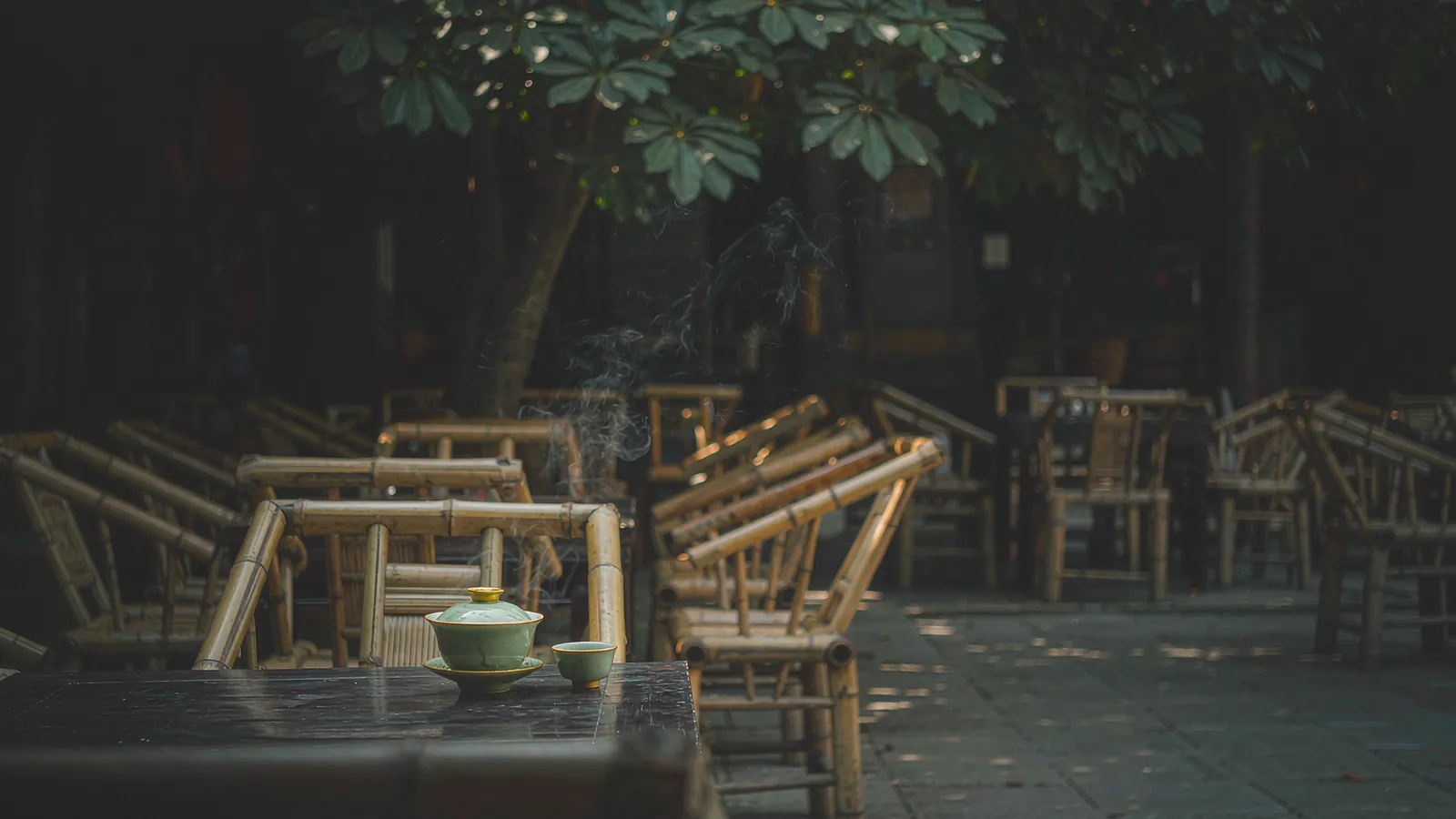
Heming Teahouse, in People’s Park. Bamboo, rattan chairs, tea by the cup, no hurry. The park around it has the matchmakers’ corner, where parents have been hanging their children’s CVs on cards and negotiating introductions for thirty years. It is the best portrait of Chengdu, and it costs twenty yuan. You are given a flask of boiling water and refill as often as you like.
Wuhou Temple and Jinli Lane. A temple of the Three Kingdoms with gardens; alongside it, Jinli is a rebuilt tourist street, but it looks good at nightfall with the lanterns lit and snack stalls out. Twenty minutes is enough.
The Sanxingdui Museum. At Guanghan, 40 km away, twenty minutes by high-speed train. It is the most important archaeological find of twentieth-century China: bronze masks 3,000 years old and a four-metre bronze tree from a civilisation that left no written record. Half a day, and worth the trip.
Wide and Narrow Alleys (Kuanzhai Xiangzi). Restored courtyards of the old city, with cafés, bookshops and restaurants. Best in the morning, before the crowd arrives.
The Giant Buddha at Leshan. 130 km to the south, 71 metres high, cut into the cliff 1,200 years ago. We recommend approaching it by boat on the river rather than on foot: the climb up the side stairs can mean a two-hour queue at weekends, and only from the boat do you see it whole, which never happens from above.
How we run it
We are at the panda base at 7:30am, always. It is the only hour of the day that justifies the twenty minutes on the road from the centre, and the only reason we recommend sleeping nearby.
For dinners we book small rooms in local restaurants and choose the menu with the owner in front of us, which avoids the classic outsider’s mistake of ordering four spicy dishes and managing none of them. We always spread it: one signature spicy dish, one mild, a vegetable and rice.
When children are travelling, we swap the hotpot dinner for a Sichuan cooking class, where everyone makes their own wok dish and then eats it. For anyone wanting more wildlife, we suggest an extra night at Emeishan, for the monkeys and the water below the temples.
How long to stay
Two nights cover the pandas, a teahouse, the centre and a decent dinner. It is the fit for most of our private tours, and it is enough to understand the city.
Three nights is what we recommend almost every time. It allows either the Giant Buddha at Leshan by boat, which takes most of a day once you count the drive out, the crossing and the return, or the Sanxingdui museum twenty minutes away by fast train, with enough calm to read the display cases rather than walk past them.
Four nights suit anyone wanting to add Emeishan, sleeping at the foot of the mountain and going up early before the coach groups, or anyone coming for the food who wants a cooking class and three different dinners of Sichuan cooking.
Note that Chengdu sits at the end of the southwestern rail axis: beyond it, Shanghai is eleven hours away by train. It is a city to stay in, not to pass through.
When to go
March to June. 10 to 28 °C, a long spring, gardens in bloom. The best time for fresh bamboo and for the pandas.
July and August. 24 to 36 °C, very humid, white sky. It is when you eat hotpot with the air conditioning on and sweat on purpose, which is a legitimate local experience.
September to November. 12 to 24 °C, our preference. The city breathes again, the food goes down better and the parks turn gold.
December to February. 3 to 12 °C, grey, damp, no snow. It never freezes, but the damp gets into your bones. It is the cheapest season for hotels and flights.
Where to stay
Near Chunxi Road and Tianfu Square. Centre, two metro lines, everything within fifteen minutes. Practical for two nights.
By Taikoo Li and Daci Temple. Our recommendation: the shopping complex built around the temple, with its seventh-century courtyard pressed against glass and steel. It is the most pleasant place to stay, to eat dinner, and to see modern Chengdu.
In Jinjiang district. A good compromise for longer stays, ten minutes from the centre.
We avoid anything beyond the third ring: Chengdu has grown enormously and the distance does not look large on a map. For anyone sleeping at Taikoo Li, the extra advantage is being able to walk back from dinner, which matters after hotpot and beer.
What to eat
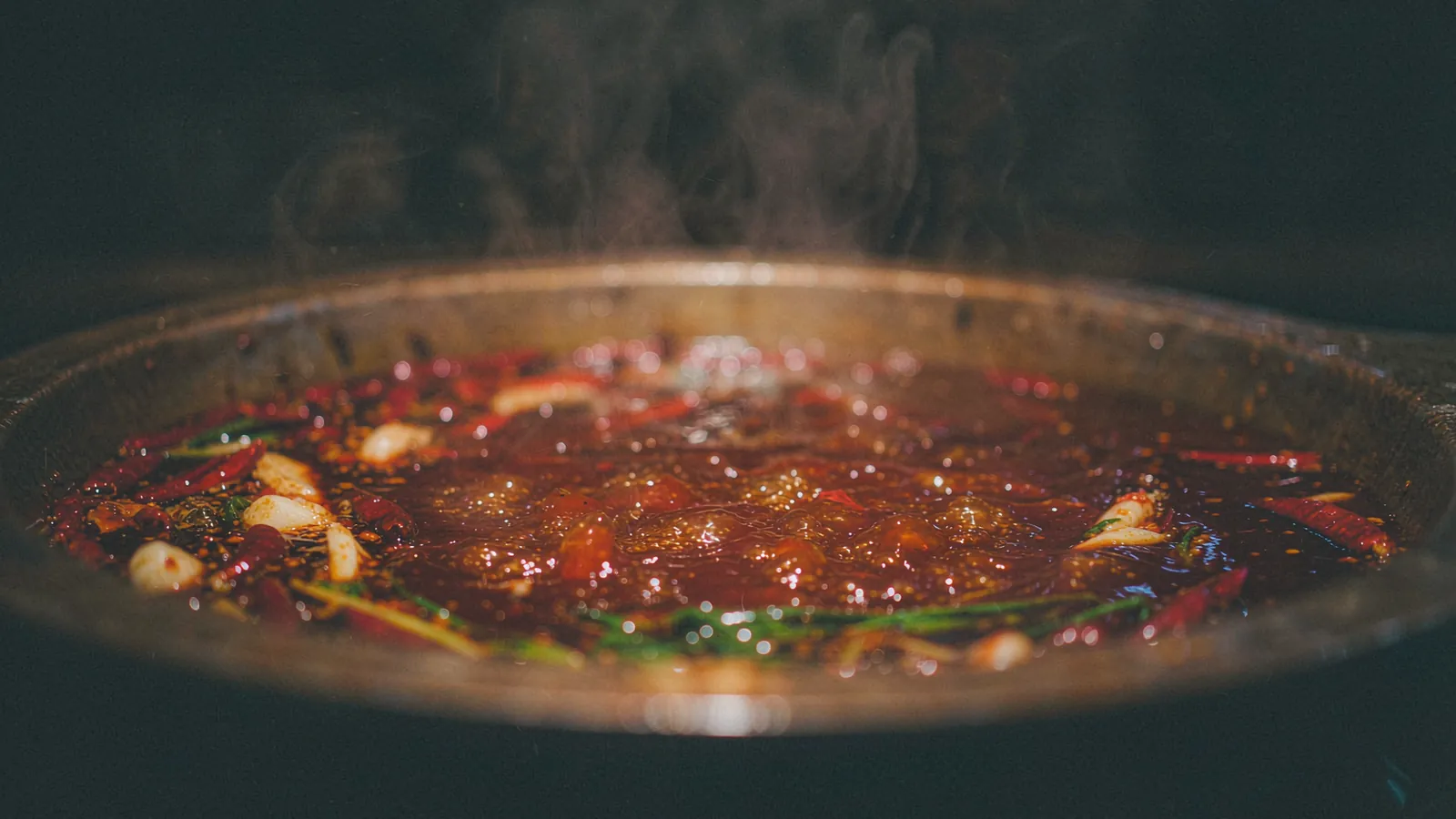
You start with Sichuan hotpot, pots of mala boiling in the middle of the table with two separate broths — one red with pepper, one mild — in which everything goes: thin slices of beef, tripe, potato, mushrooms and tofu. Everything gets dipped in sesame sauce afterwards.
Then the list of essentials: mapo tofu at Chen Mapo Doufu, founded in 1862; dandan mian, noodles with minced meat and sesame paste; Kung Pao chicken, done properly here; twice-cooked pork (huiguorou); and chuanchuan skewers, paid for by the weight of the sticks left on the table.
For sweets: glutinous rice cakes with brown sugar. To drink: local beer, and Sichuan green tea from the teahouses, served at any hour.
Getting there
Two airports. Tianfu (TFU), international, opened in 2021, 50 km out, with metro line 18 taking about 40 minutes. Shuangliu (CTU), closer to the city, with most of the domestic flights.
By high-speed rail: Xi’an–Chengdu in 3h to 4h, Chongqing in 1h to 1h30, Beijing in 7h to 9h, Shanghai in 11h. It is the gateway for almost all our southwestern tours, and Xi’an–Chengdu is almost always done in a single travel day, arriving in time for dinner.
Where most agencies get it wrong here
Going to the pandas mid-morning. The base opens at 7:30am and by 10am the animals are asleep in the shade. We have never understood why some agencies arrive at 11am; the result is a client photographing backsides. We enter at opening time, every time.
Walking up the Leshan Buddha at a weekend. The queue on the side stairs reaches two hours, and the view from above never shows the Buddha whole. We go by boat: twenty minutes across, the statue in full in front of you, no queues at all.
Serving a dinner made only of spicy dishes. It is the most common mistake, and the one most often made with Europeans. We always put together four dishes spread across the range — one spicy signature dish, one mild, a vegetable and rice — and explain at the table what Sichuan pepper is, numbing the tongue without burning it.
Skipping Sanxingdui. It is twenty minutes by train and it is the most important archaeological find of twentieth-century China: bronze masks 3,000 years old from a civilisation with no written records. Half a day there is worth more than Jinli at nightfall, and almost nobody puts it on the programme.
Doing the city in two hours. Chengdu is not a city of monuments with fixed opening times; it is a street city. What you gain here is gained by sitting two hours in a teahouse, with a rattan chair and a pot on the table.
None of our Chengdu days include visits to factories, silk shops or commission-paid teahouses: every private tour we organise in China is sold at a closed price, with no compulsory shopping.
Keep reading
How we organize it
01
We arrive early
We get into the monuments before the tour buses. The Wall at 7am, the Forbidden City at 8:30am.
02
A Portuguese-speaking guide
One guide from the first day to the last, in Portuguese. No handing you over to someone new in each city.
03
We handle the bookings
We take care of the named reservations that need a passport, including the ones that sell out in high season.
Frequently asked questions
What time should you see the pandas?
Between 7:30am and 10am. That is when they are eating bamboo, because it is when food is distributed around the base. After that they sleep on their backs and the visit loses nearly all of its interest.
Is Sichuan food always spicy?
No. Sichuan pepper — the real thing, the one that hums and numbs your tongue — is aromatic, not hot. Fiery chillies do exist, but every restaurant has mild dishes, and we always tell you what to order.
How many days for Chengdu and the surrounding area?
Two nights cover the pandas, the city and a teahouse. Three allow a trip to the Giant Buddha at Leshan and to the Sanxingdui museum without rushing, which is what we recommend.
Is it worth going to the panda volunteer programmes?
Only on long stays. Volunteer placements involve cleaning enclosures, start at 8am and have to be booked months in advance. For most travellers, the visit to the Chengdu base is enough.
How do you handle spicy food in local restaurants?
By asking for sauce on the side and a plate of plain rice. Our guide explains the heat level of each dish at the table and orders for anyone who would rather not take the risk.
Tours that include Chengdu
Talk to the people who run it
Want Chengdu in 2 to 3 nights, or a different way round?
Tell us how many you are, when you want to go, and what cannot be left out. We shape the itinerary from there.
Chat on WhatsAppReplies in English · no obligation