Destinations
Xi'an
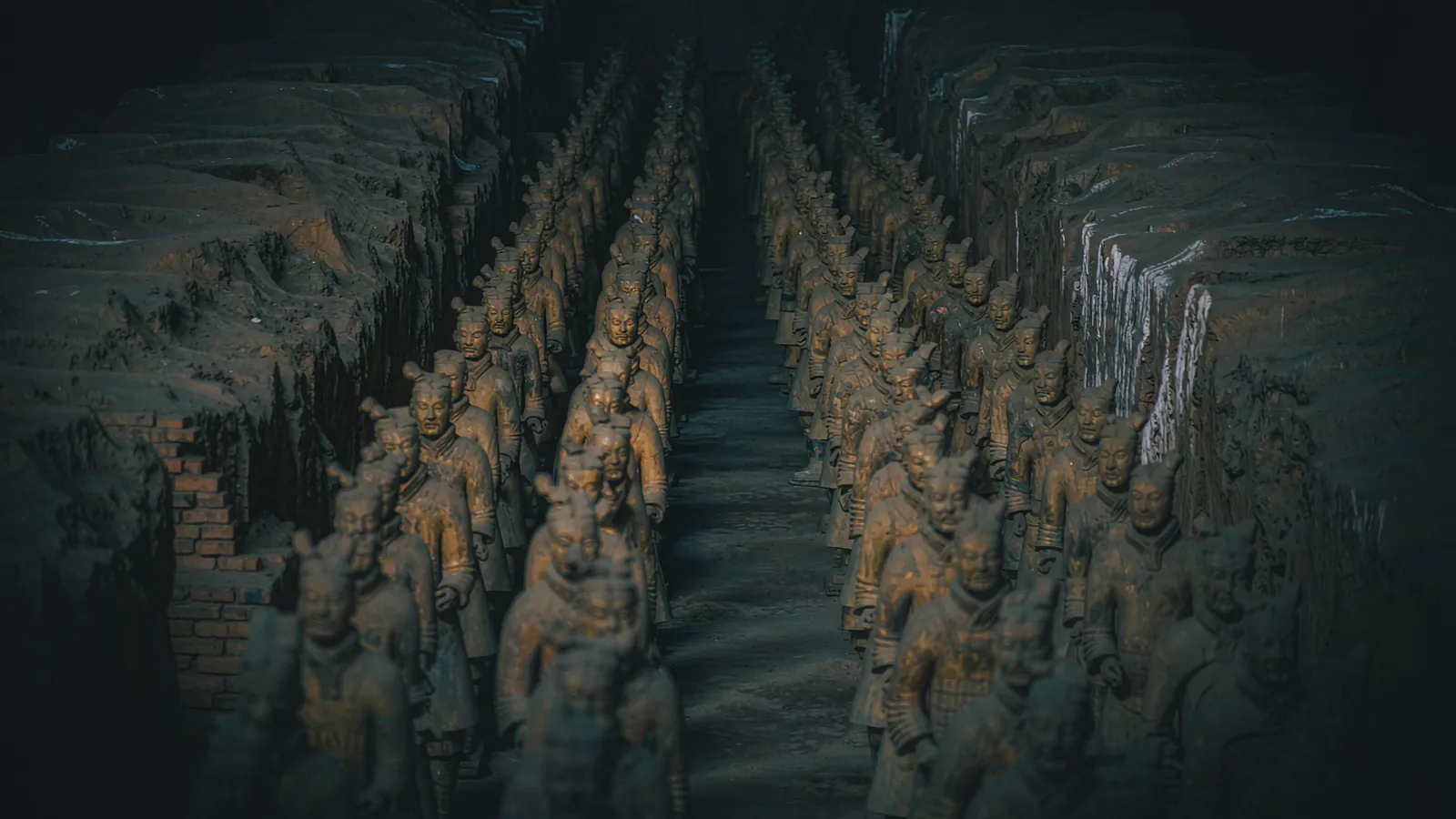
Eight thousand terracotta soldiers, every one with a different face. And a city wall you cycle along at sunset.
At a glance
- Best time to visit
- Mar–May · Sep–Nov
- Suggested nights
- 2 nights
- Region
- Centro
- Booking required
- Terracotta Army · Shaanxi History Museum
Xi’an is where the Silk Road began, and it was the capital of thirteen dynasties. Today it is a provincial city of twelve million people, with a walled historic centre you cross on foot and the country’s most famous archaeological site. It is also the natural second chapter of any first trip to China: three and a half hours from Beijing, or four and a half, by high-speed train.
Why go
Because this is where two thousand years of Chinese imperial history become visible in actual objects rather than only in ruins. No other Chinese city lets you stand, in a single morning, in front of a rank of eight thousand clay warriors modelled 2,200 years ago, and then cycle, that afternoon, along the top of a 600-year-old brick wall.
It is also a city still lived at a human scale: neighbourhood markets with street food, teahouses in the late afternoon, a centre you can cover without transport. For anyone looking for travel in China outside the Beijing–Shanghai axis, Xi’an is the stop where the country becomes legible. It stands at the point where the Silk Road split into two branches, and it is still the Chinese city where more things are eaten with the hands, from torn-up bread, than with chopsticks.
What to see and do
The Terracotta Army. At Lintong, 40 km east. Four pits under hangars, visited in this order — Pit 1, the largest, holding the main army; Pit 3, the command post; Pit 2, deliberately left half-excavated so you can see what it looked like before digging began; and finally the on-site museum, with the two half-scale bronze chariots. Every figure has different features: the hairstyle, the moustache and the armour all vary. Allow at least three hours.
The Huaqing hot springs. On the way back, on the slope of Mount Li. These are the imperial baths of the Tang dynasty and the setting of the 1936 incident that changed the course of the Chinese civil war. Half an hour is enough, but it justifies the stop.
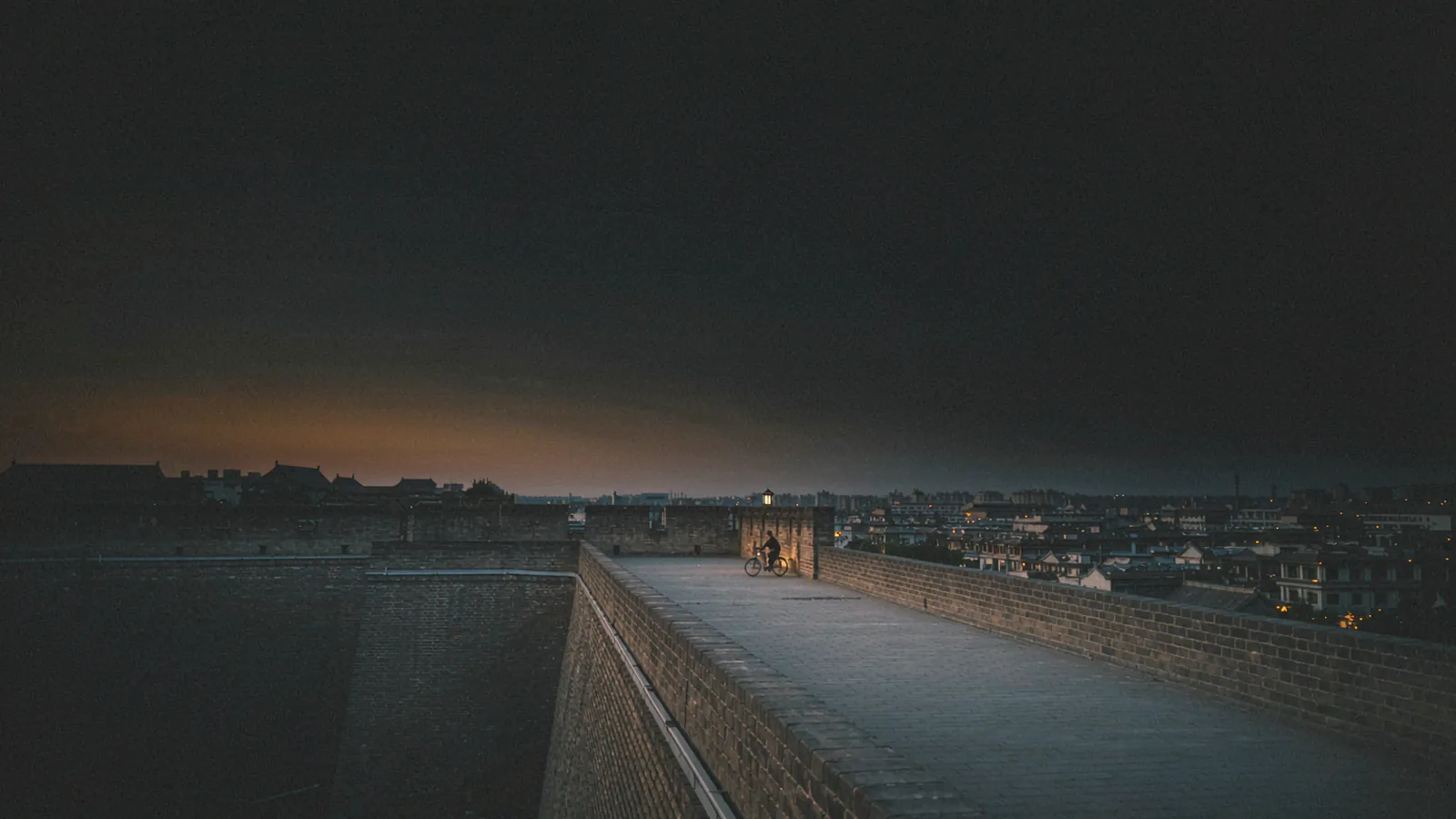
The city wall. Thirteen kilometres and seven hundred metres of perfect rectangle, twelve metres high, wide enough to cycle along the top. We enter at the South Gate, Yongningmen, the most restored and the one next to the Muslim quarter. You hire a single bicycle or a tandem and return it at any of the four main gates. It stays open until 10pm in summer. We ride the southern stretch in about an hour, stopping at the watchtowers, and come down at Yongningmen in time for sunset.
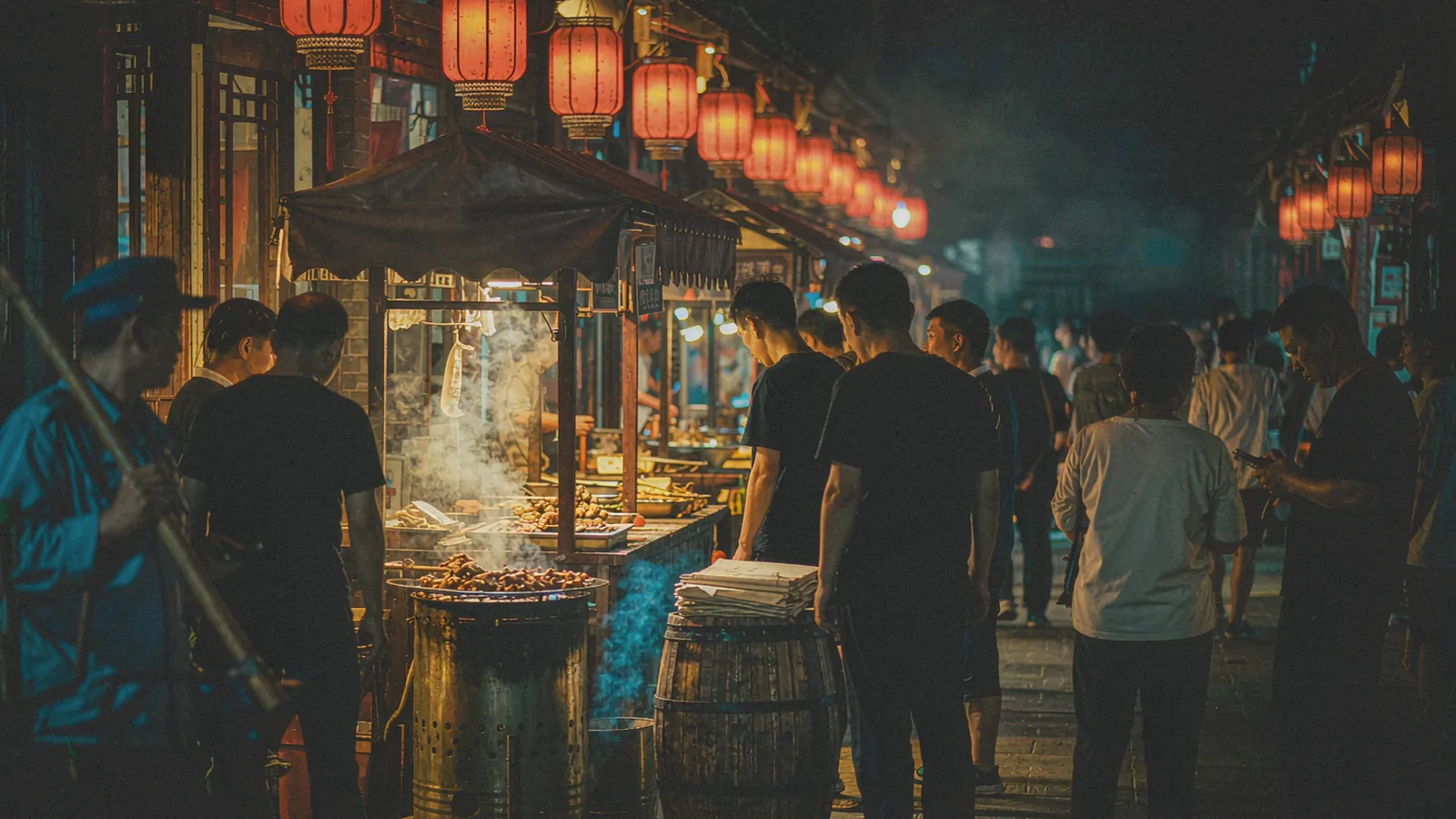
The Muslim quarter. Bei Yuanmen is the tourist part of it; going in that way and turning immediately afterwards into the lanes Xiyangshi and Dapiyuan is where you find the locals. Next door stands the Great Mosque of Xi’an, built in Chinese style with garden courtyards — one of the oldest mosques in the country and still in use.
The Giant Wild Goose Pagoda. Built in 652 to house the scriptures brought back from India by the monk Xuanzang. You climb up inside. At night the square to the north holds the largest fountain show in Asia, starting around 8:30pm in summer.
The Shaanxi History Museum. Free, but with limited real-name reservations, which we book days in advance. Closed on Mondays. It is the best provincial museum in China for understanding the dynastic sequence without reading a book.
How we run it
We always do Xi’an west to east, connecting by high-speed rail to Beijing or to Chengdu. The Terracotta Army day starts at 7:30am with pickup at the hotel and an immediate departure for Lintong, to be at the ticket gate before 8:30am. Groups get here at 10:30am; the difference between going in first and going in later is being at the railing or behind three rows of people.
We always bring in the site’s own guide for the first forty minutes, because the excavation technique is something our guides know but which lands differently coming from the archaeologist. The afternoon is left free for two hours — tired travellers go back to the hotel, the rest stay at the museums.
If a traveller wants to climb Mount Huashan, we book a full day and warn them that the steps are serious. A fast train takes 40 minutes to Huashan North station, the cable car goes up to the West Peak, and you come back late in the day. We always flag the plank walk along the cliff face well in advance: it uses a harness, costs extra, and is not for anyone with a fear of heights.
How long to stay
Two nights cover what matters: a morning at Lintong, the wall in the late afternoon, the Muslim quarter for dinner and the Giant Wild Goose Pagoda after dark. It is the pace we use on our ten-day private tours, and nobody leaves feeling they missed the essentials.
Three nights let you add the Shaanxi museum without rushing, plus an excursion: Mount Huashan, two hours in transit plus six of walking, or Famen and the mausoleum of Qin Shi Huang on the same day. For anyone who values museums, the third night pays off better here than in any other city on the axis.
One night — what plenty of travel agencies in China propose — forces a choice between the warriors and the city, and usually loses both: you arrive at Lintong at 11am, eat in a hurry and leave for the station at 4pm. We do not recommend it.
When to go
March to May. 8 to 26 °C, dust possible in March, but good light and parks in bloom.
June to August. 24 to 38 °C, humid, with heavy thunderstorms in the afternoon. The Terracotta Army sits inside hangars with no air conditioning — morning is mandatory.
September and October. 8 to 22 °C, the best time. Avoid 1 to 7 October, Golden Week: the site receives tens of thousands of visitors a day.
November to March. -5 to 8 °C, dry, with strong heating in the hotels. The snow peaks of the Qinling to the south are visible on clear days. This is when you find the emptiest city.
Where to stay
Inside the walls, in Beilin district. It is the only place that makes sense: you are ten minutes on foot from the South Gate of the wall, from the Bell Tower and from the Muslim quarter.
Within that area we prefer the side streets near the South Gate over the frontage onto the Bell Tower: the view is worse but the nights are quiet, which counts for something because traffic passes the Bell Tower all night.
For anyone wanting to move up a category, the courtyard houses in Xi’an converted into boutique hotels, near the south wall, are the best in our portfolio. Staying outside the second ring only pays if you have a private car at the door, which is the case on our private tours.
What to eat
Xi’an’s food is northwestern food: wheat and mutton, not rice. Yangrou paomo is the dish of the city — you tear bread by hand into your bowl and hand it back to the kitchen, which covers it with mutton broth simmered for hours.
Then there is roujiamo, shredded pork inside flat bread, eaten in Xi’an at breakfast; biangbiang mian, broad thick noodles with chilli and garlic on top; liangpi, cold starch noodles with vinegar and chilli oil; and guokui, bread baked against the wall of the oven. In autumn, fried persimmon cakes are sold from the stalls of the Muslim quarter.
Local beer, and Shaanxi green tea to cut the fat. For longer dinners, the Shaanxi restaurants with a hall for skewers and live music are usually down the lanes off South Gate avenue.
Getting there
Xianyang airport (XIY) is 40 km northwest. It is connected by metro line 14, about 50 minutes, or by taxi for around 150 yuan and 45 minutes.
By high-speed rail, Xi’an North has frequent direct services: Beijing in 4h30 to 6h, Shanghai in 6h to 7h30, Chengdu in 3h to 4h. We always book numbered first-class seats and take care of check-in — passport in hand, because identity checks at the stations are done by name.
All our programmes include pickup at the airport and the station, and private transfers to Lintong on the Terracotta Army day. None of this works well on the tourist coaches that leave the Bell Tower at 9am.
Where most agencies get it wrong here
Starting Lintong late. The 9am tourist coach reaches the site near 10:30am, exactly when the hangars are full. We leave the hotel at 7:30am and are inside at 8:30am, with the air still fresh in the hangar.
Doing the four pits in the wrong order. Almost everyone goes to Pit 1 first, spends an hour there, and reaches 2 and 3 already tired. We invert it: we begin at Pit 3, the command post, small and full of context, and keep the main army for the end.
Offering Mount Huashan as an afternoon excursion. These are serious steps, six to seven hours for anyone doing the circuit of the peaks; the West Peak cable car solves the ascent but not the way back. We sell it as a full day, with a warning about the plank walk, or we do not sell it at all.
Serving yangrou paomo already broken up in the kitchen. The bread is meant to be torn by hand, into fingernail-sized pieces, because that is what gives the broth its texture. Where it arrives done, they are cooking for groups. We choose places that put the bowl and the basket in front of you.
Giving the Muslim quarter an hour. People stay on Bei Yuanmen, which is the shop window, and never go into the Xiyangshi and Dapiyuan lanes, where the real eating happens. We book two hours of an evening there and skip the sit-down dinner.
Our private tours through Xi’an include no stops at jade factories or silk shops. That is a choice: it costs us commission and it gains us two hours a day.
Keep reading
How we organize it
01
We arrive early
We get into the monuments before the tour buses. The Wall at 7am, the Forbidden City at 8:30am.
02
A Portuguese-speaking guide
One guide from the first day to the last, in Portuguese. No handing you over to someone new in each city.
03
We handle the bookings
We take care of the named reservations that need a passport, including the ones that sell out in high season.
Frequently asked questions
Is the Terracotta Army worth visiting?
It is, but arrive early. It opens at 8:30am and we are at the gate at 8:15am. After 10am the queues inside the hangars make it impossible to get close to the railing and study the detail of the faces.
Can you cycle on the Xi'an city wall?
Yes. The perimeter is close to 14 km, bicycles are hired up on the wall for about 45 yuan an hour plus a deposit, and you return them at any of the four main gates. The last hour of the afternoon is best.
How many days do you need in Xi'an?
Two nights cover the Terracotta Army, the wall, the Muslim quarter and the Giant Wild Goose Pagoda. Anyone wanting to climb Mount Huashan needs a third night.
What do you eat in Xi'an that you cannot eat anywhere else?
Bread torn up by hand into mutton broth, the yangrou paomo. It is a ritual: you break the bread into small pieces yourself and the kitchen hands it back to you turned into soup.
Is Xi'an a cheap city?
It is one of the most affordable provincial capitals in China. A large bowl of noodles costs 20 to 30 yuan, and dinner with two dishes and beer comes to under 150 yuan for two people.
Tours that include Xi'an
Talk to the people who run it
Want Xi'an in 2 nights, or a different way round?
Tell us how many you are, when you want to go, and what cannot be left out. We shape the itinerary from there.
Chat on WhatsAppReplies in English · no obligation