Destinations
Guilin and Yangshuo
The landscape printed on the 20-yuan note — and one no photograph quite delivers.
At a glance
- Best time to visit
- Apr–Jun · Sep–Oct
- Suggested nights
- 2 to 3 nights
- Region
- Sul
- Booking required
- No booking required
The karst peaks between Guilin and Yangshuo are the most reproduced image in China, and they sit on the 20-yuan banknote. Seen in person, they are taller than photographs suggest and stranger: towers of limestone rising sheer out of the plain with no hillside around them, shaped by a hundred million years of rain dissolving the rock.
Why go
Because this is the only region in the country where the landscape, not the monuments, is the reason to travel. A week in China runs through palaces, temples and museums; Yangshuo is where you spend two days looking at rock and water, and cycling among rice fields with water buffalo.
It is also the most relaxed destination in our portfolio. There are no queues, no compulsory monument reservations, no crowds outside public holidays. It works as an interval in the middle of a more urban itinerary, and it is what we consistently recommend for anyone looking for travel in China at a slow pace, and for our honeymoon trips.
What to see and do
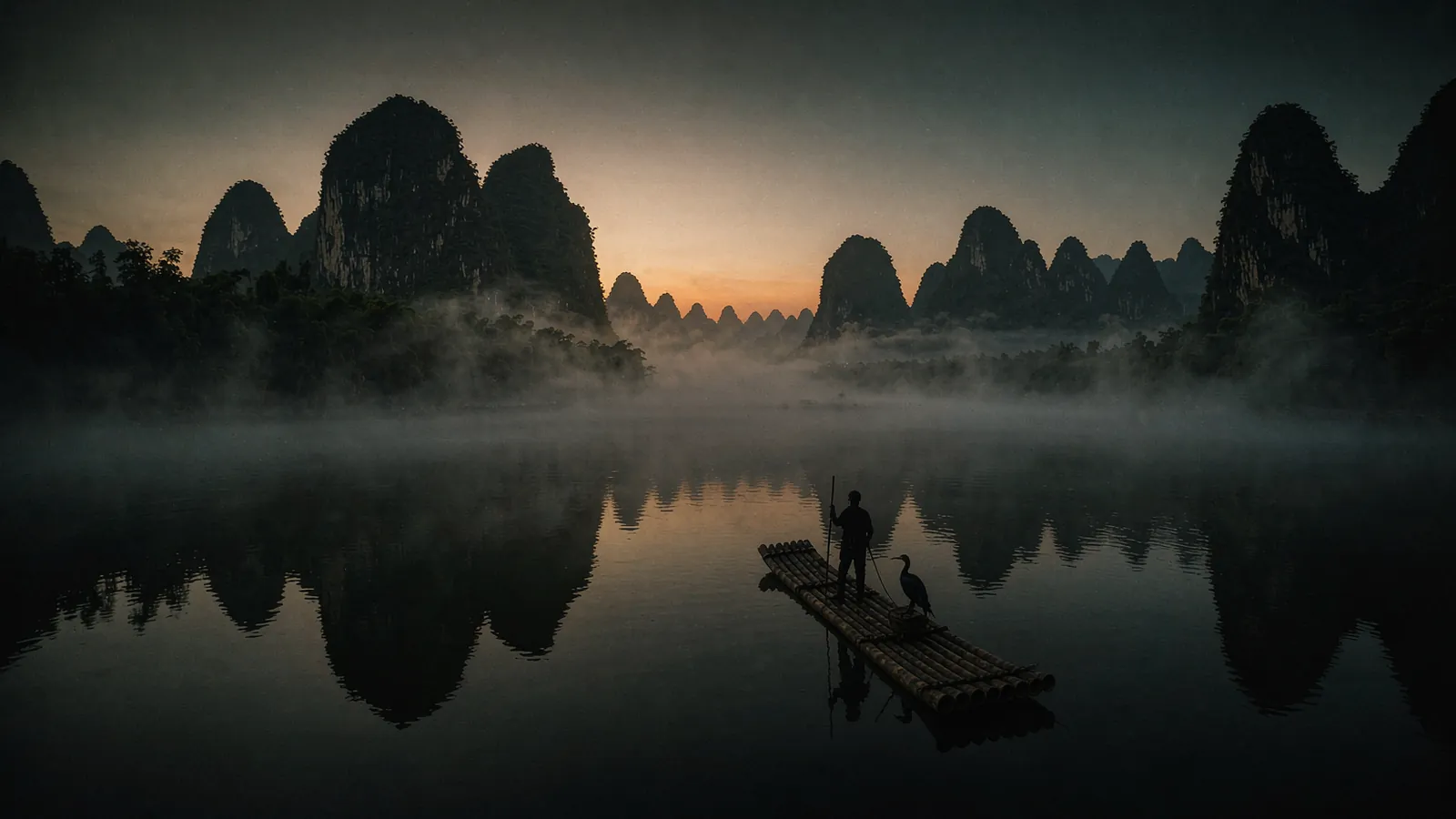
Bamboo raft on the Li river. Made of canes lashed together with a small motor, carrying four people, passing beneath the peaks between Xingping and Yangdi. This is the stretch printed on the 20-yuan note. It is done in the morning or late afternoon; at midday the light is vertical and photographs come out washed out.
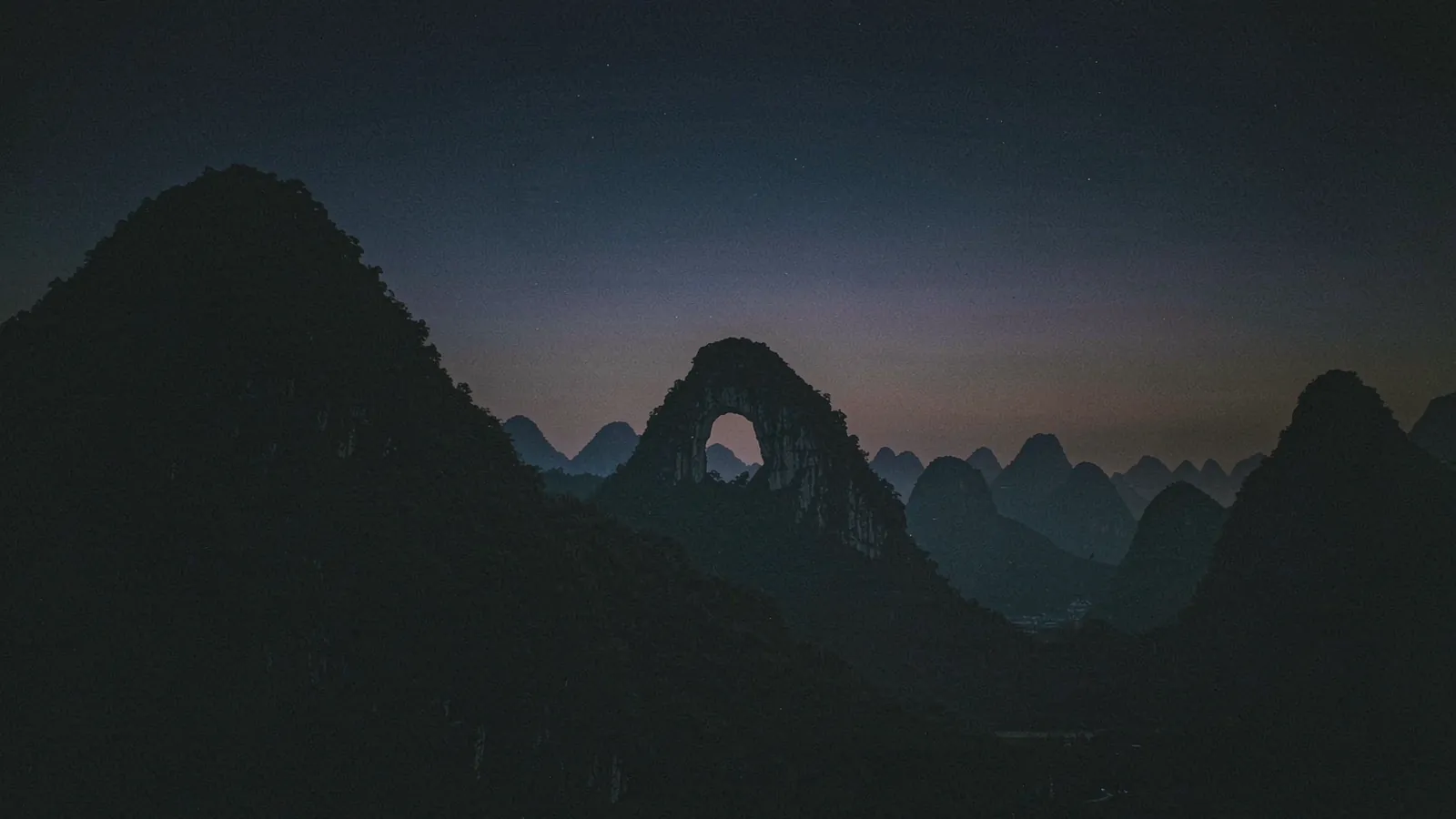
The Xianggong viewpoint. Across the river, this is the classic vantage point for sunrise over the bend of the Li. It is a twenty-minute climb up a stone stairway in the dark: we leave the hotel at 4:30am. It is the most photographed spot in southern China — it rewards the hour, not the equipment.
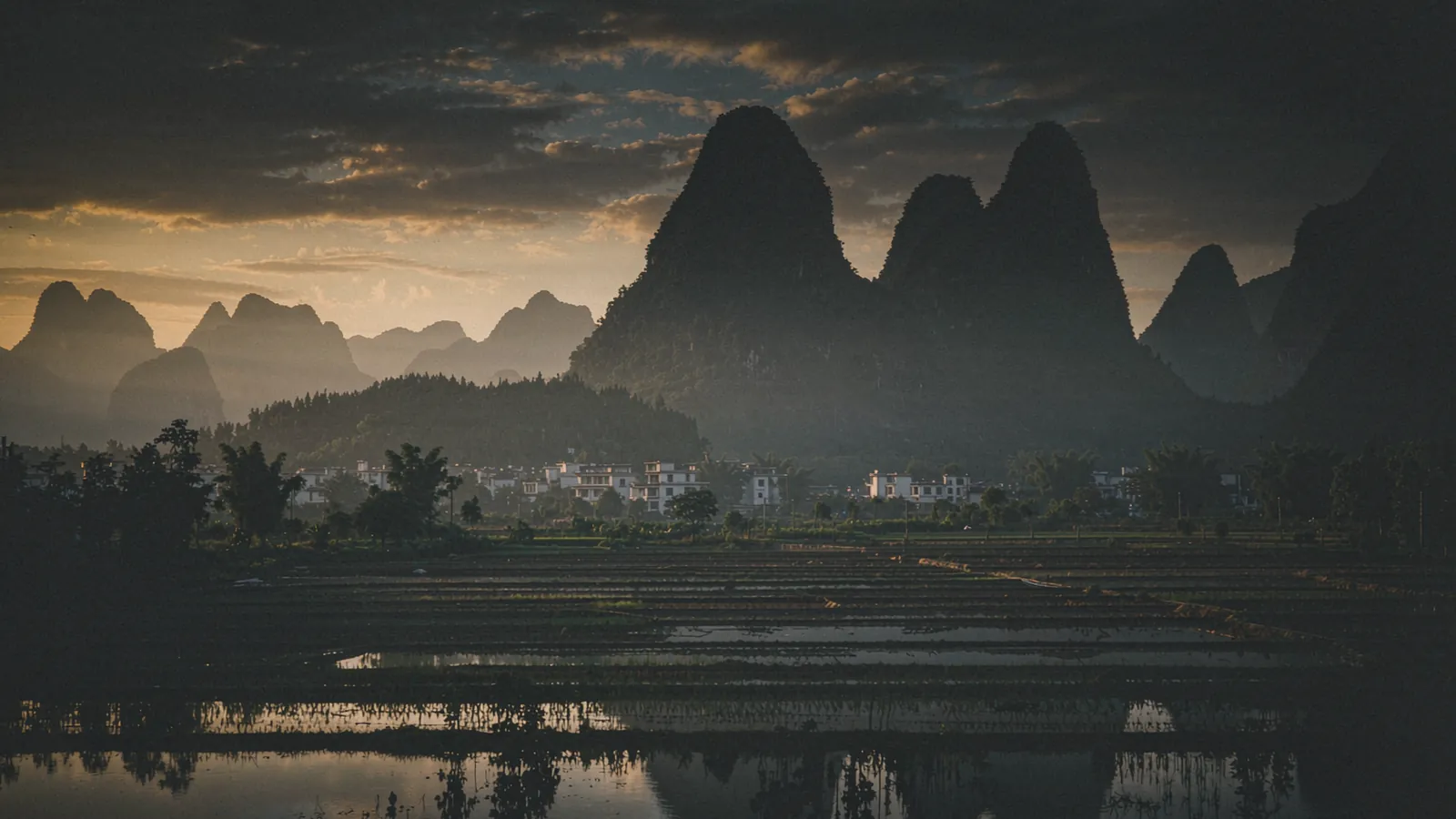
Cycling through the rice fields. Flat road between villages along the Yulong river, crossing stone bridges eight hundred years old and passing tangerine farms. We hire good bicycles, with gears; the cheap rentals in Yangshuo give trouble on the dirt detours. The usual route is 15 to 20 km on flat ground, stopping at the stone bridges and the threshing floors of the villages.
The Reed Flute and Seven Star caves. Colour-lit stalactites near Guilin, visited in half an hour when it rains — the alternative we keep for days of heavy rain.
Climbing at Yangshuo. The karst rock here is one of the best natural schools in the world. We run a half afternoon of introduction with an instructor for adults and children from eight years up, with our own equipment.
The villages of Xingping and Fuli. The first with grey brick houses and piers on the riverbank; the second with the market where tangerines and bamboo baskets are sold. Neither charges admission.
How we run it
We always put our travellers in Yangshuo rather than Guilin. Guilin is where the train or plane arrives, but sleeping there costs an hour of transfer every day, in both directions. We book hotels and guesthouses on the bank of the Li river or outside the village, where you hear the fields at night instead of the karaoke on West Street.
We schedule the raft and the Xianggong sunrise on non-consecutive days, to allow a morning of rest. We always warn that sunrise here depends on the mist: in April and May there are days when you see nothing and it has to be repeated another morning. There is always a second opportunity written into the programme.
We buy raft tickets days ahead in high season, because the number of boats is limited and the 10am queue can take an hour.
How long to stay
Two nights is the sensible minimum: a morning for Xianggong and the river, an afternoon cycling through the rice fields, and an evening in the village. Enough to understand why this landscape ended up printed on a banknote.
Three nights is what we recommend on all our honeymoon trips and photographic routes. It leaves room to lose one sunrise to mist, to add the Yulong river by raft, and to fit a climbing or cooking afternoon without trains colliding.
One or two nights with accommodation in Guilin is something we do not recommend at all: it means two hours a day in transfers, and the best thing about Guilin is leaving it.
Anyone travelling from July to August should count on heat with no shade among the peaks; anyone travelling from December to February should count on grey days. In both cases Yangshuo is still worth the trip — but it is honest to say so before booking.
When to go
March and April. 12 to 22 °C, spring of rapeseed in flower and trees in blossom. It rains one afternoon in two. This is when the paddies begin to flood and reflect the sky.
May and June. 20 to 30 °C, humid, with heavy short thunderstorms at the end of the day. The river water stays cloudy for days. It is the worst time for photography, but the fields turn green.
July and August. 25 to 35 °C, scorching, busy. The peaks offer no shade. We only recommend it to those already in the region over the summer who want to see the paddies full of water.
September and October. 18 to 28 °C, dry, clear skies. The best season of all. The fields ripen to gold in late September, before the harvest.
November to February. 6 to 16 °C, grey, with days when the mist never lifts. It never gets properly cold — and the region is nearly empty and cheaper.
Where to stay
In Yangshuo, with three options: on West Street, where there is movement, bars and noise until one in the morning; on the bank of the Li river, with a view onto the peaks and silence — our recommendation for couples; or in the villages among the rice fields, twenty minutes by bicycle, for anyone wanting to be entirely off the tourist map.
In Guilin we sleep only one night in transit, when the train arrives late. In those cases we pick hotels near Shanhu Lake, ten minutes from the centre.
What to eat
The speciality is beer fish, carp from the Li river braised in beer with tomato, spring onion and chilli — the lid is lifted off the pan at the table. Then there are river snails with beer, chicken wrapped in lotus leaf, cooked until the bone comes away, and river crabs in chilli sauce, eaten with the hands and a local beer alongside.
For breakfast, Guilin rice noodles: mifen, in a bowl of broth with braised pork, peanuts and pickles to taste. It is served at the neighbourhood houses along Zhongshan Road from 6am.
In the villages around Yangshuo we organise meals at family farms, with vegetables picked that moment. None of it is staged tourism; these are houses where we eat ourselves.
Getting there
Guilin Liangjiang international airport is 30 km from the city and has frequent direct links with Beijing, Shanghai and Guangzhou.
By high-speed rail: Guilin to Guangzhou in 2h30, to Shenzhen in 3h, to Shanghai in 8h, to Beijing in 10h30. For most of our tours it is Guangzhou–Guilin or Shanghai–Guilin, after which the region is covered with a private car and guide.
The transfer from Guilin city to Yangshuo takes 1h15 by road, and the last 20 minutes runs already among the peaks. It is one of the arrivals our clients remember most. Between Guilin and Yangshuo there is also the Zhujiang pier and the motorway; we always take the same regional road, with no scheduled stops at the caravan parks.
Where most agencies get it wrong here
Sleeping in Guilin. You save on the hotel and pay two hours a day on the road. Yangshuo today has properties of better quality than the big city, and it is where you are when the peaks wake up at 6:30am.
Selling the Guilin–Yangshuo cruise as the highlight. It lasts four hours and takes three hundred people on a boat with a fixed timetable. A private raft on the same stretch lets you stop, cut the motor for ten minutes and listen to the river — it passes the same peaks and costs less per head in a group of four.
Booking the Xianggong sunrise with no plan B. It is a twenty-minute climb made in the dark and it depends on the mist: in April and May, more than half the mornings are not worth the 4:30am alarm. We always hold a second morning in the programme.
Hiring bicycles at the West Street counter. They are single-speed city bikes and you get punctures on the dirt between the paddies. We bring bicycles checked the day before, with helmets on request and a support trailer for children.
Fitting climbing and rafting into the same day. Karst rock demands a full half afternoon of concentration; after two hours hanging on the rock, nobody enjoys the river. We always separate the two activities into different days.
There is no hurry to defend in Yangshuo: two to six travellers, a private guide, the car at the door, and no shop stops on the programme.
Keep reading
How we organize it
01
We arrive early
We get into the monuments before the tour buses. The Wall at 7am, the Forbidden City at 8:30am.
02
A Portuguese-speaking guide
One guide from the first day to the last, in Portuguese. No handing you over to someone new in each city.
03
We handle the bookings
We take care of the named reservations that need a passport, including the ones that sell out in high season.
Frequently asked questions
Is the Li river cruise or the Yangshuo raft the better option?
The private raft at Yangshuo. The large Guilin–Yangshuo cruise carries three hundred people on a fixed schedule; the motorised bamboo raft moves at the traveller's pace and passes the same peaks.
How many days in the region?
Two nights in Yangshuo. Three allow the sunrise climb to the Xianggong viewpoint, the cycling route through the rice fields, and a raft on the Yulong river without hurrying.
Should I stay in Guilin or in Yangshuo?
Yangshuo. Guilin is a transit city with thirty years of concrete stacked on it; Yangshuo is the village among the peaks. Sleeping in Guilin costs an hour of road in each direction.
Does it rain a lot in southern China?
Between April and August, yes, with short heavy thunderstorms. It does not stop visits, but it can spoil the sunrise at the viewpoint. We always keep a second dawn in reserve.
Is this a good destination for children?
One of the best: rafting, cycling on flat roads, a climbing session on the rock and cooking lessons at the farms. That is why it features in our Family Panda Route.
Tours that include Guilin and Yangshuo
Talk to the people who run it
Want Guilin and Yangshuo in 2 to 3 nights, or a different way round?
Tell us how many you are, when you want to go, and what cannot be left out. We shape the itinerary from there.
Chat on WhatsAppReplies in English · no obligation