Best time to visit · Yunnan
best time to visit Yunnan
Month by month: the dry season and the monsoon, the Yuanyang terraces mirrored and golden, the altitude of Shangri-La and the two windows of the year when the province crosses with roads open.
At a glance
- Best time to visit
- Mar–May · Oct–Dec
- Suggested nights
- 5 to 7 nights
- Region
- Sudoeste
- Booking required
- No booking required
The best time to visit Yunnan is a question answered with a map in hand, because the province does not have one climate, it has several. There is the Kunming plateau, which people call the city of eternal spring; there is Shangri-La and the Tibetan slopes, well above three thousand metres; and there is Xishuangbanna, at the southern extreme, tropical and hot. On the same route you gain one thousand four hundred metres of altitude and go from a coat to short sleeves. What unifies everything is the rhythm of the rain: a dry season, from November to April, and a monsoon, from May to October. This page answers “when to go to Yunnan” and complements the Yunnan page.
Yunnan’s climate, month by month
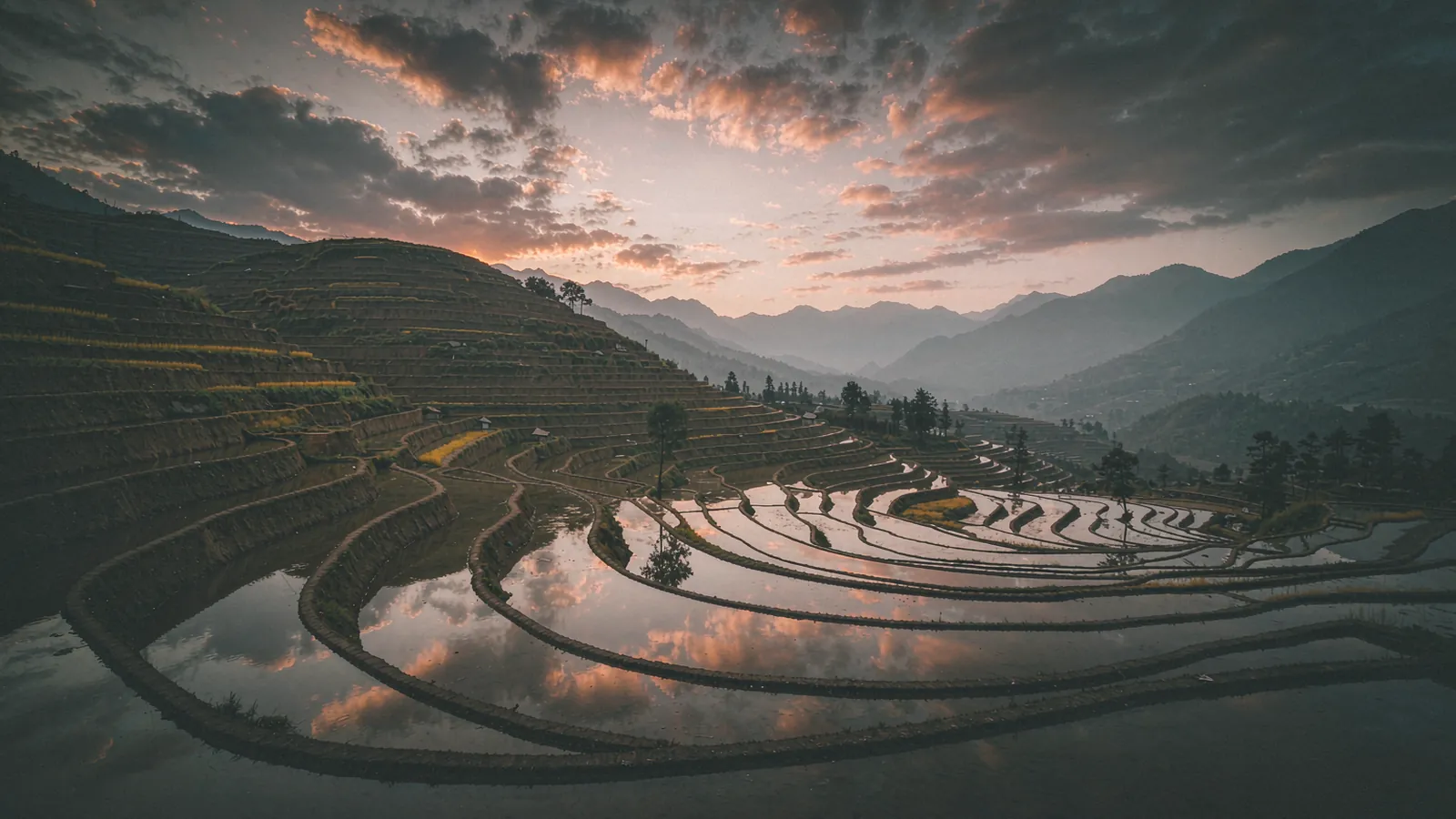
Winter, December to February. Dry and mild on the plateau, cold in the high areas. It is the season of the flooded Yuanyang terraces, which reflect the sky and give the best-known image of the province, and of the rapeseed fields in flower in the east. Shangri-La and the mountain roads can suffer from snow and ice, with occasional closures, so access to those areas should be confirmed the day before. It is a season of fewer visitors and cheaper hotels, and of short days that force an early start.
Spring, March to May. One of the two good windows. Temperatures rise, the slopes fill with flowers and the azaleas of the high areas appear between May and June. April brings the water festival of the Dai communities in the south, one of the most striking experiences in the province and one of the reasons to choose this month. The roads are dry and the mornings clear. The only trade-off is the gradual arrival of humidity at the end of May.
Summer, June to August. The monsoon. The rain falls with intensity and continuity, the mountain roads suffer from water and landslides, and the terrace slopes go green but are often covered by low cloud. July and August add the school holidays to this. It is not a dangerous season, and some people prefer it for the green landscape and for the roads empty of tourists; but it is the one most likely to force a change in the daily plan.
Autumn, September to November. The other window. September can still have rain in the first half, but from the second half the humidity drops, the sky opens and the harvests appear on the terraces. October and November are the best months in the province: dry air, clean light, roads in good condition and pleasant temperatures from the plateau to the tropical south. November also marks the start of the flooding of the terraces, which extends the interest into winter.
The best moment for each experience
The Yuanyang terraces have two dates: mirrored from November to March, gold in the week before the harvest, in September. Kunming and the plateau lakes work in any month, and gain from clear sky. Dali and Erhai lake, and Lijiang with its old canal centre, ask for mild temperatures and dry sky, which points to spring and autumn. Shangri-La and the Tibetan areas have their own window, May to June and September to October, and are conditioned by snow in winter. Xishuangbanna, tropical, is a winter destination: since it is hot there when the plateau is cold, the months from November to April are the best. The markets, the villages and the teahouses do not depend on the season and are the reserve plan for any day.
Holidays and peak periods
Yunnan is a holiday destination for the Chinese themselves and for a long time was their favourite, which shows in the calendars. The national holiday week from 1 October lands on the best month of the year: Lijiang and Dali fill up, the terrace viewpoints have tripods set up from 06:00 and hotels sell out. The first week of May and Lunar New Year follow the same logic. Outside those windows, July and August bring the school holidays. The answer is the usual one: villages and valleys during the day, viewpoints at dawn and late afternoon, and bookings made in advance.
When not to go to Yunnan
July and August are the months we advise against for a first route through the province, because of the rain and its effect on the mountain roads. The national holiday week is the other one to avoid, for crowds and for prices. Winter is not on this list: for anyone who wants to see the mirrored terraces, December and January are precisely the right months, and the cold of the plateau is solved with layers. What we do not do is go up to Shangri-La in winter without confirming the state of the road.
What to pack, season by season
Layers in any month: it is the only rule that works in a province with this range. In winter, a warm coat for the mornings and the high areas, hat and gloves for Shangri-La, and light clothing for the tropical south. In spring, light layers and a folding rain shell, because humidity starts to climb in May. In summer, a proper rain shell, shoes with a sole that grips mud, and clothes that dry quickly; the humidity does not lift. In autumn, layers and a coat for nights on the plateau. In every season, sunscreen and sunglasses: the radiation at this latitude and this altitude is strong, even when it is cold. And allow time for the altitude, with short stages and rest nights between them.
How the season changes the daily plan
In the dry season, from November to April, the days are predictable and give a lot: dawn on the terraces, road in mid-morning, market or village in the afternoon and low light at the end of the day. In winter, with short days, you start later and count the hours of light, cover fewer kilometres and stay longer in each place. In spring the light is the best of the year and the days allow the province to be covered with margin. In summer the plan depends on the road: confirm the state of the accesses the day before, avoid long transfers after lunch and always keep an afternoon for standing still. The climb in altitude is never done in one jump, in any month.
What to do when it rains
The monsoon rain is not a shower that passes: it is rain that lasts. When it arrives, what matters is having anticipated it. The old towns of Dali and Lijiang have arcades, covered courtyards and teahouses in quantity, and work well with water. The covered markets and the provincial museums are the plan for the afternoons. The temples and monasteries have lit interiors and hold up on any day. What drops out is the long mountain roads, the terrace viewpoints and the walks. And it is worth remembering that this rain is also what keeps the landscape green: anyone who gets it in a reasonable dose still sees the province looking better than on the posters.
The calendar in four lines
The best moment is October and November, and then March and April: dry air, roads in good condition, clear sky and the two great images of the province, the harvests and the flowers. The second choice is December to February, dry and mild months, with the mirrored terraces at their best and the roads empty. The weeks that ask for thought are those of June, when humidity starts to climb, and the first half of September. The ones to avoid are July and August, for the monsoon, and the national holiday week, for the crowds.
Fitting the right season into a trip
Yunnan is the province best travelled outside the rainy months, and also the one that gains most from consecutive days of clear sky. On the Grand Crossing the region is the long chapter of the southwest, and October and November give the whole trip in perfect conditions: from Tibet to the plateau, with the monsoon already withdrawn. On Photographic China we look for the two ends of the dry season, when the terraces are mirrored or gold and the dawns in the mountains are not lost in cloud. For the full destination listing, go back to the Yunnan page.
Frequently asked questions
What is the best time to visit Yunnan?
October to December and March to May. These are the two ends of the dry season, with roads in good condition, clear sky and mild temperatures on the plateau. October and November give the light and the harvests; March, April and May give the flowers and the azaleas on the higher slopes. Between the two, the winter months also work well.
Should summer be avoided in Yunnan?
July and August are the least recommendable months. It is the peak of the monsoon: heavy, continuous rain, mountain roads affected by water and landslides, and the terrace slopes green but without the light of the rest of the year. The province does not close, but the probability of a route having to change because of weather is high.
When is the best time to see the Yuanyang terraces?
Between November and March, when they are flooded and work as mirrors reflecting the sky; December and January are the months with the most stable water. In September, in the week before the harvest, they turn gold. From June to August they are green and often covered by low cloud. The date changes the image more than at any other point on the route.
Can you go to Shangri-La at any time?
You can, but conditions vary a great deal. Shangri-La is well above three thousand metres, and in winter the access roads can suffer from snow and ice, with occasional closures. The best moment is May to June, with the slopes in flower, and September to October, with dry air and clear sky. In summer the monsoon rain arrives up there as it does across the province.
Does Yunnan have the same climate everywhere?
No, and that is why the date has to be chosen carefully. Kunming is known for its almost permanent spring, Shangri-La has an altitude climate, and Xishuangbanna, at the southern extreme, is tropical and hot. In the same week you can go from a coat to short sleeves, which forces packing in layers and planning the climb in altitude by stages.