Journal
How much time you need to see China
Four days in Beijing, seven in Yunnan, twenty on the Silk Road. The time each region actually demands, and how much fits into each trip.
October 18, 2026 · ChinaTravel.pt Team · planning · itineraries · comparison
Four days in Beijing, two in Xi’an, seven in Yunnan and twenty on the Silk Road. China has no single answer to how much time it demands, because it is not a country: it is a continent with the area of Europe and ten regions that ask for different rhythms.
The most common mistake is not going for too little time — it is going for too little time to places that demand a lot. Zhangjiajie in two days gives you a park seen from a bus. Yunnan in four gives you three airports and no mountains.

The time each region takes
Beijing, four days. Three nights is the minimum: a day for the Forbidden City, Jingshan and the hutongs; a full day for the Great Wall, because Mutianyu eats half a day on the journey out and back; a third for the Temple of Heaven or the Summer Palace. Four days let you combine the last two and still have a free morning.
Xi’an, two days. Decisive and fair: the Terracotta Army early in the morning, the wall by bicycle at sunset, the Muslim quarter at dinner. A third day serves for the Shaanxi History Museum or Hua Shan, but it is not compulsory.
Shanghai, three to four days. The Bund, the old city and the former concessions in one day; Suzhou or Hangzhou on the second; museums and Pudong on the third. Four days work well with both satellite cities included.
Chengdu, three days. The pandas in the morning, the centre in the afternoon, and a full day for Leshan and the Giant Buddha. Anyone who only wants the pandas does it in two.
Guilin and Yangshuo, four days. Three is the minimum for the raft, the bicycle and the climb up to the Xingping viewpoint, and the fourth allows doing nothing — which is half of what is good about Yangshuo.
Zhangjiajie, three to four days. The park is enormous and the zones are connected by internal buses of 30 to 40 minutes. Two days give you a view; three give you the park; four give you Tianmen Shan along the way.
Yunnan, seven to ten days. Kunming, Dali, Lijiang and Shangri-La chain together in seven well-run days, but ten allow you to catch the right light and the roads without hurry. Fewer than seven is a waste.
Tibet, eight to ten days. The permit requires a closed itinerary, and the altitude requires days of acclimatisation: Lhasa, at 3,650 metres, is not done the day after a flight from sea level.
Silk Road, twenty days. The Gansu corridor, Dunhuang, the Taklamakan desert, Xinjiang and the climb onto the plateau. There are six-hour road stages.
Hong Kong and Macau, three to four days. Two cities separated by an hour of ferry, each with a character of its own.
What fits into each length
Seven days. One region done well, or two classic cities. Beijing and Xi’an, with four and three days, work particularly well because they complete each other. What does not fit is a third city.
Ten days. The number that sorts out a first trip: the three classic cities, with time in all three. It is our Essential China.
Fourteen days. The three cities plus a whole region — the right choice for anyone who does not know when they will come back. This is where Chengdu, Guilin or Zhangjiajie come in.
Eighteen to twenty days. One region in full. Yunnan in depth, or Tibet, or our Grand Crossing.
Twenty-five days or more. It starts to be worth splitting into two trips. Not out of tiredness: because the internal flights and the region changes begin eating days that would have given you whole regions.
And if you only have five days?
Five days on the Chinese mainland give you one city done well, or two merely seen. Our recommendation is clear: one city, with two trips out of it.
Beijing in five days works well: two days for the city and the hutongs, a full day for the Great Wall, and two days for the Summer Palace, the Temple of Heaven and whatever is left over. Not a single minute is lost on transfers.
Shanghai in five days is the modern alternative: three days for the city and two for Suzhou and Hangzhou, both under an hour away by train. It gives a completely different kind of trip, and it is the best choice for anyone who has already been to China.
What you should not do with five days is add Beijing and Xi’an together. That is five hours of train, plus transfers at each end, and the result is two cities seen at a run.
The time that does not count as visiting time
There are three days that are always lost, and that nobody puts into the count:
The arrival day. A flight from Lisbon lands in the morning, and between immigration, the transfer, check-in and eight hours of jet lag, that day yields nothing. Count it as lost.
The day you change region. A five-hour train journey, plus an hour of transfer at each end, eats the whole day. That is why we always alternate a travel day with a visiting day.
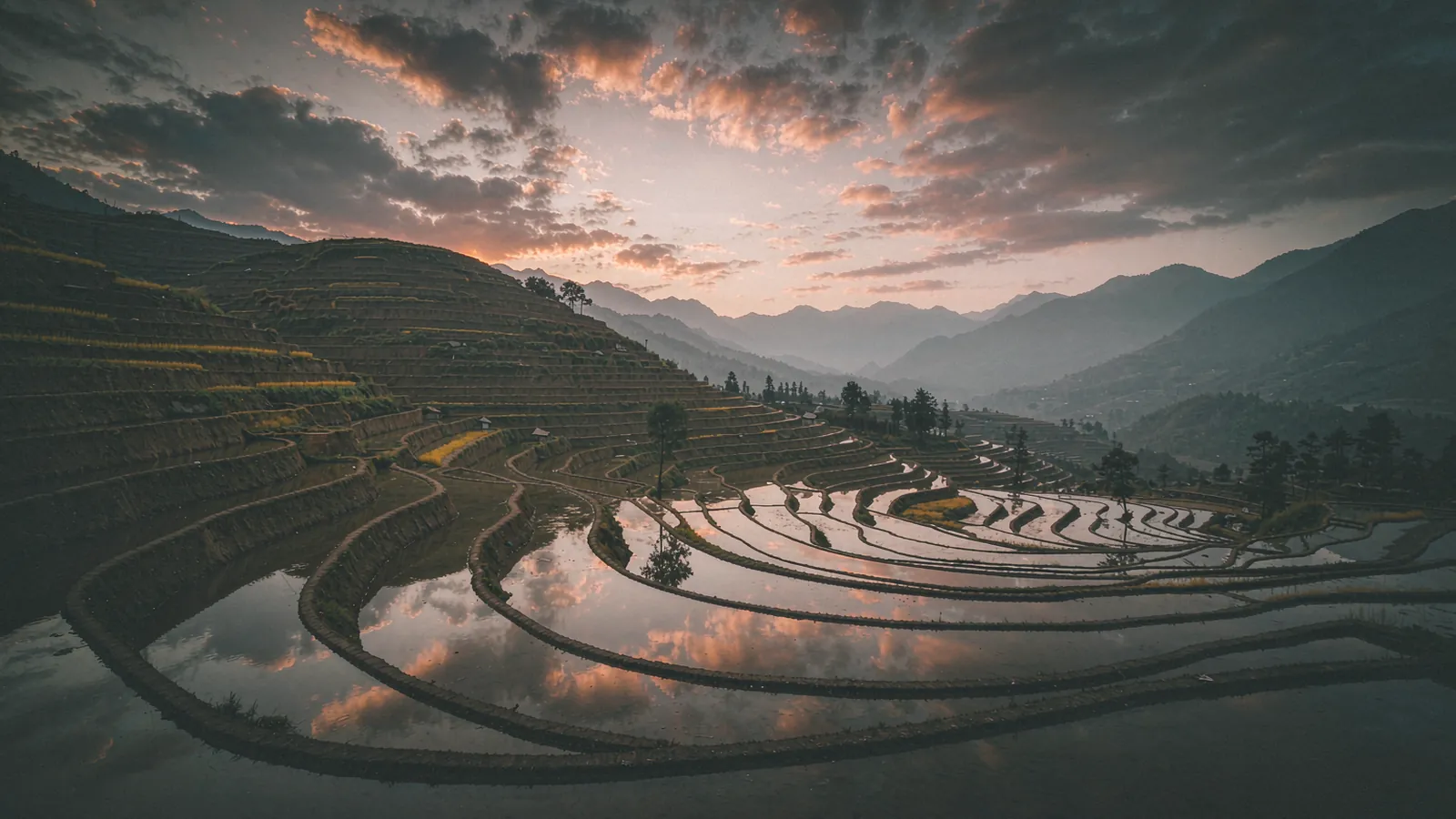
The buffer day. We always put one free morning into itineraries that depend on light. In Zhangjiajie, on the rice terraces of Yunnan and at sunrise on the Li river, the mist decides.
Where time is won
If the problem is having too few days, there are three ways of gaining time without cutting anything:
Well-chosen internal flights. Xi’an to Shanghai by plane saves four hours; Beijing to Guilin the same. We replace train with plane whenever the leg runs past six hours.
Sleeping where you visit. In Zhangjiajie we sleep inside the park. In Yangshuo we sleep in the village and not in Guilin. It saves an hour a day in each direction.
Bookings handled in time. A sold-out named ticket does not cost you only the visit: it costs the whole morning at the gate and the reorganisation of the following day.
Our advice
If you are going to China for the first time and are unsure how many days to book, choose twelve and not ten. Twelve days absorb a region off the classic axis, and that region is almost always the thing people remember — not the Forbidden City, which they had already seen in photographs.
And if your time is short, the right decision is to cut a city rather than shrink the days in each one. China seen badly does not repay a twelve-hour flight.
Either way, any travel agency with real experience of China will tell you the same thing: extra days do not fix a badly distributed itinerary. What fixes it is two cities measured properly and a free morning.
For anyone who wants the opposite extreme, the Grand Crossing runs twenty days and needs every one of them. And for anyone who wants altitude, Lhasa demands days of acclimatisation that are not negotiable.
Frequently asked questions
How many days do you need to see the essentials of China?
Ten days for the three classic cities: four in Beijing, two in Xi'an and four in Shanghai, counting the journeys. It is the minimum from which the trip has a rhythm, rather than being a succession of stations.
How many days do you need per region?
Beijing, four; Xi'an, two; Shanghai, three to four; Chengdu, three; Guilin and Yangshuo, four; Zhangjiajie, three to four; Yunnan, seven to ten; Tibet, eight to ten; Silk Road, twenty.
Can you see China in two weeks?
Yes, and it is the best length for a first trip. Fourteen days give you the three classic cities plus a whole region — Yangshuo, Chengdu or Zhangjiajie — without having to run, and with two days of slack in the middle.
And to see the whole country?
You do not see the whole country on any single trip: China has the land area of Europe. For a proper crossing — the Gansu corridor, Xinjiang and the Tibetan plateau — twenty days are needed, and that is what we do on the Grand Crossing.
Keep reading
Talk to the people who run it
Want to know how this applies to your trip?
Message us on WhatsApp. We reply in English within one business hour (UTC+8).
Chat on WhatsAppReplies in English · no obligation