On the ground
Chinese food: what to eat and how to order it
Eight regional cuisines in one country. Street food is safe, chilli is a choice, and breakfast is the best meal of the day.
Skip the hotel buffet. The best meal of your trip will be in a room with fifteen tables and a QR-code menu.
Updated October 18, 2026
Skip the hotel buffet. The best meal of your trip will be in a room with fifteen tables, a QR-code menu and the noise of a family having dinner at the next table.
Eight cuisines, one country
Talking about “Chinese food” is like talking about “European food”. There are eight great regional traditions, and a serious trip passes through at least three:
Cantonese (Guangdong). The best known in the West and the most restrained: steaming, fast wok work, live seafood, dim sum. The principle is not to disguise the ingredient. It is the basis of what is eaten in Hong Kong and Macau.
Sichuan. The most intense. Sichuan pepper that numbs the tongue, chillies that burn, fermented bean paste and black vinegar. Dishes: mapo tofu, hotpot, dandan mian, twice-cooked pork, kung pao chicken.
Hunan. Dry heat, without the numbing effect of Sichuan pepper, with a lot of garlic and pickles. Dishes: beer fish, smoked pork belly with bamboo shoots, fried bean curd.
Shanghai and Yangtze cuisine. Sweet and savoury, dark sauces, long reductions. Dishes: braised pork belly (hongshao rou), hairy crab in autumn, xiaolongbao, shengjianbao.
Beijing and the north. Wheat instead of rice, mutton, dark bean sauce. Dishes: Peking duck, zhajiangmian, onion pastries, lamb skewers.
Muslim northwest. Hand-pulled noodles, mutton, cumin. It is the cuisine of Xi’an and Lanzhou.
Yunnan. Wild mushrooms, goat’s cheese, cured ham, sour herbs and the influence of Southeast Asia.
Tibetan and minority cuisines. Tsampa, yak butter tea, momos, dried meat. High-altitude food, built to warm you up.
Do not miss the Hui cuisine of the Muslim communities of the northwest: hand-pulled dough, mutton and cumin, present in Xi’an too. And notice one thing that feels strange at first: in China there is no cheese and no bread on the table, and the meal has no starter, main and dessert — everything arrives at once and is eaten in whatever order you like.
Breakfast is the forgotten meal
It is the best and the cheapest. In the northern cities you eat wheat dough, steamed buns, eggs and hot soy milk, from 6am. In Shanghai and Canton, steamed pastries and congee, the rice porridge eaten with fish, century egg and pickles. In Xi’an, bread soup with mutton at seven in the morning.
We recommend our clients eat at least two breakfasts outside the hotel. It is where you watch the city wake up and where you realise that China eats better in the morning than at night.
Hotpot: how it works
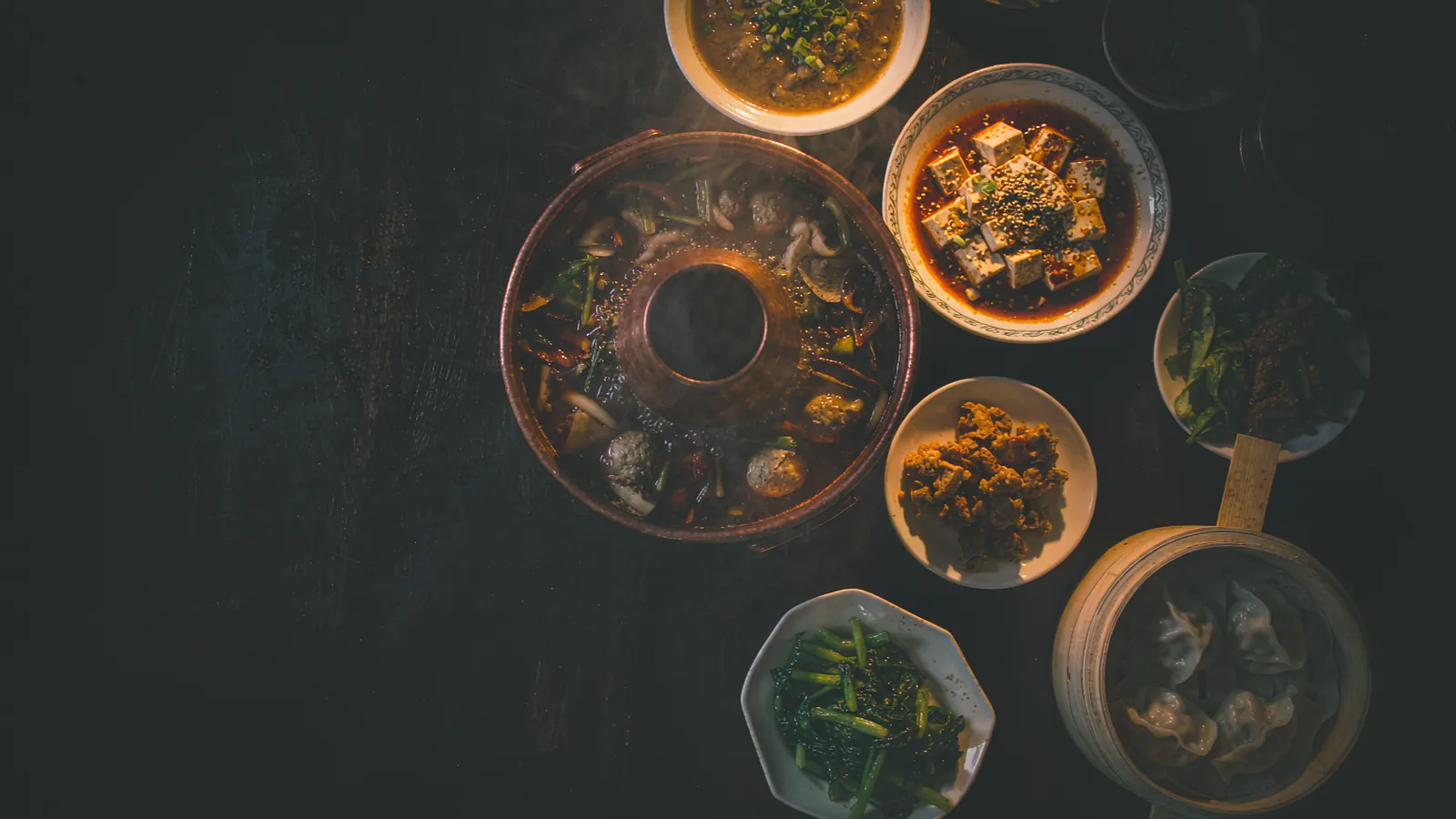
The meal that scares people most at first sight and the one they repeat most afterwards. A pot arrives in the centre of the table, often divided into two broths: a red one with chilli oil and a mild one.
You cut each ingredient from the trolley — thin slices of beef, tripe, prawn balls, mushrooms, tofu, potato, bamboo shoots — and cook it at the table, counting the seconds: liver and tripe take ten, potato takes five minutes. You lift it out with chopsticks and dip it in the sauce each person has mixed in their own bowl: sesame, garlic, coriander, vinegar and chilli oil, to taste.
Two rules: do not drink the broth with a spoon at the end (it is only fat and chilli), and do not put anything into the mild side of the pot if the whole group is sharing it.
Dim sum: how it works
It is eaten in the morning and at lunch, almost never at dinner. In Canton and Hong Kong the large rooms are full by 8am. You choose by ticking a paper sheet or by pointing at the trolleys passing between the tables: siu mai, har gow (translucent prawn dumplings), rice rolls, chicken feet in black bean sauce, radish cakes, mango pudding.
Green or Pu’er tea accompanies it and cuts the fat. Lift the lid of the teapot when you want it refilled — it is the custom, and it works.
Vegetarians, restrictions and children
Say what you do not eat before you sit down, with the guide confirming it in writing in Chinese. Buddhist cuisine is an excellent solution: dishes without meat, fish, garlic or onion, served in temples and in restaurants bearing the symbol of a leaf.
For children, plain white rice, scrambled eggs with tomato, simple noodles and a banana work anywhere in the country. It is what we always order for our family groups.
How to choose a restaurant without speaking Chinese
Four criteria we use, in order of reliability:
- A queue of locals. An empty house at 7pm in mainland China is a bad sign; a house with people at the door is half the battle won. Stalls and street restaurants turn over quickly, so the local clientele is the most reliable menu there is.
- A short, specialised menu. Restaurants that do five things do them well; menus of two hundred dishes in four languages are a tourist-zone trap.
- Kitchen in view. Where you can see the wok and the pot at the counter, food is cooked to order. Where everything comes from behind a curtain, it is a matter of luck.
- Opening hours. Dinner is early: most neighbourhood houses close the kitchen between 9pm and 9.30pm, even if the room stays open. Anyone dining at 10pm in a small city eats badly, or eats in a hotel.
As for ordering: with a QR menu there are almost always photographs, and that is the simplest route. Without a QR code, point at the next table. The phrase that solves everything is “wǒ yào zhège” (“I want this”), accompanied by a finger. For chilli, “bú yào là” sorts it; “wēi là” asks for a little.
Hygiene, without paranoia
Eat where there are people, prefer what is cooked to order, avoid ice in drinks at small establishments and have your hands washed beforehand. Beyond that, Chinese street food is safe, and the rate of food problems among our clients is very low — largely because of the choice of places, which is our job.
What we do
On every tour we choose restaurants by cuisine and clientele, not by decor. We book signature dinners days in advance, prepare a list of recommended dishes in Chinese for each traveller, and adapt every meal to dietary restrictions and to each person’s chilli tolerance. In Sichuan and Hunan this is not a luxury: it is the difference between a memorable meal and an evening of suffering.
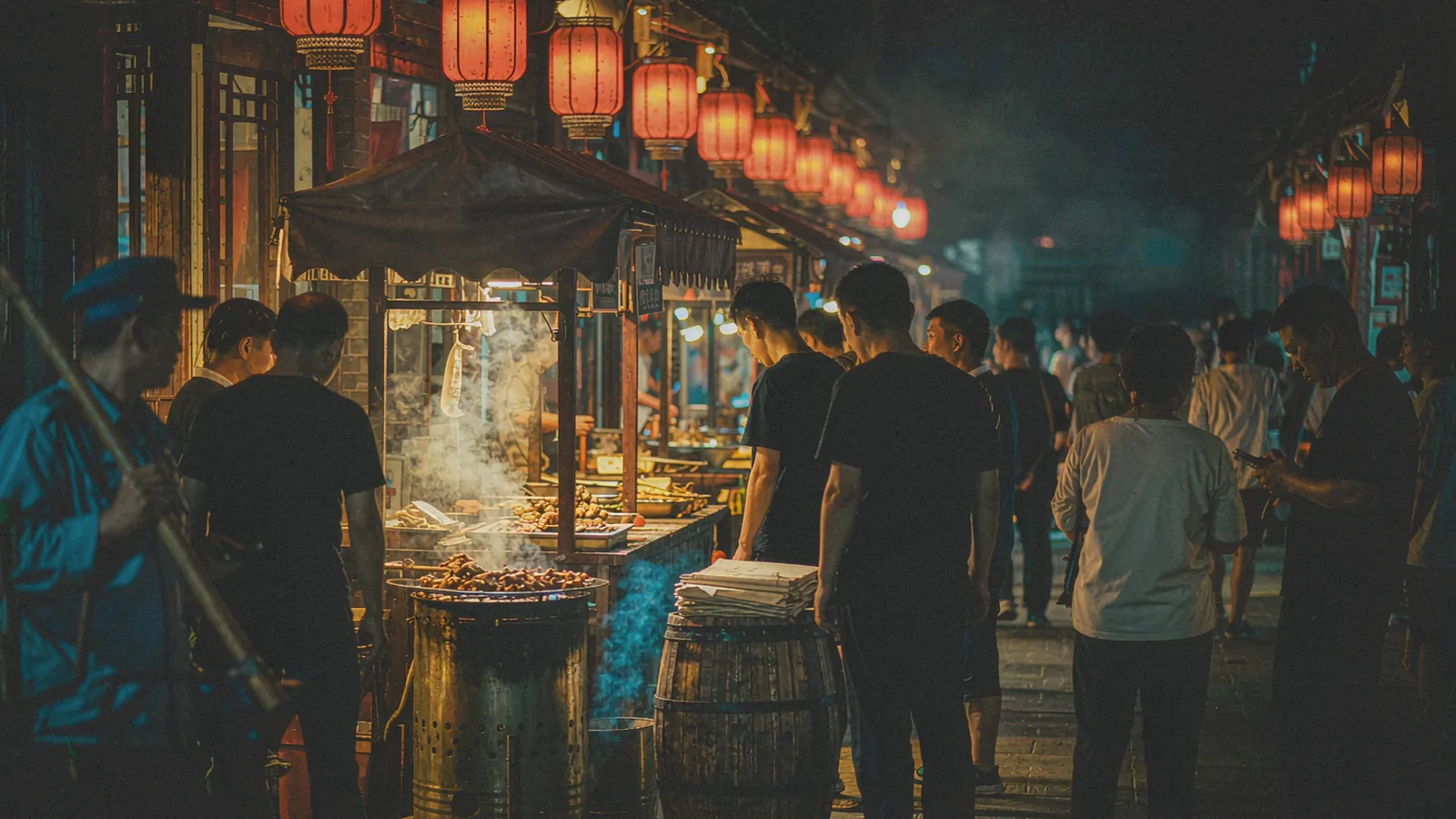
We also spread the order across the table, and we do not leave the client to order alone: one signature dish, one mild dish, a vegetable and rice, always with a soup to share. It is the rule that lets a table of four taste all of Sichuan without anyone ending up drinking milk in secret. And we include, at least twice per tour, a market or a street of stalls — because that is where the best food is, and where no group agency goes.
Frequently asked questions
Is Chinese food always spicy?
No. Only Sichuan, Hunan, Guizhou and parts of Yunnan are spicy by nature. Canton, Shanghai and the north are mild. Even in the spicy regions, any restaurant has dishes without chilli, and you simply say "bú yào là".
Is street food safe?
Yes, if you choose stalls with a queue of locals and food cooked to order in front of you. Avoid raw food exposed to the heat and salads washed in water of unknown origin. For most of our clients it is the best food of the trip.
How do you order in a restaurant with no English menu?
Through the QR code on the table, which opens a menu with photographs, or by pointing at what other people are eating. Say "wǒ yào zhège" — I want this — and it is sorted. Failing that, show the guide the list of dishes we prepare before the trip.
Are there vegetarian options?
Many, but confirm: some vegetable dishes are made with meat stock. Say "wǒ chī sù" — I eat vegetarian — and the guide confirms it at the table. Chinese Buddhist cuisine is an entire tradition of dishes without meat or garlic, served in temples.
Is it rude not to finish everything?
No — leaving food on the serving dish is a sign that you were served enough, which is seen positively. Refusing a whole dish from the outset is what to avoid. Always try a little of what is served.
Where this applies
Talk to the people who run it
Still got a question about chinese food: what to eat and how to order it?
Message us on WhatsApp. We reply in English within one business hour (UTC+8).
Chat on WhatsAppReplies in English · no obligation