Journal
How many days to spend in China
Seven days give you three cities. Twelve let you breathe. Twenty are a different trip. The right number depends on what you do not want to miss.
October 18, 2026 · ChinaTravel.pt Team · planning · itineraries · first trip
The right question is not how many days China needs. It is how many days you do not want to lose in stations. From there, the number produces itself.

Seven days: two cities, or three done badly
With seven days on the Chinese mainland, counting the arrival and departure days, five useful ones remain. Divided by three cities, that is a night and a half in each place, two hours of train between each one, and the constant feeling of being on your way somewhere.
Our recommendation for anyone with only a week: two cities, at ease. Beijing and Xi’an, linked by a five-hour high-speed train, work particularly well because they complete each other — the imperial court, and the archaeology that explains how it was possible.
If the choice is Beijing and Shanghai, that is also good, but be ready for two modern cities of brutal scale and no view of the interior of the country. For a first trip, Xi’an explains more.
Ten days: the number that works
Ten days is the balance point. It gives Beijing, Xi’an and Shanghai with time in all three, two hotel changes instead of four, and at least two mornings on which you do not have to be up before eight.
That is why our Essential China has exactly ten days. The distribution we use:
- Beijing, three nights. Forbidden City, Jingshan and the hutongs in one day; the Wall at Mutianyu on the second; the Temple of Heaven at dawn or the Summer Palace on the third.
- Xi’an, two nights. The Terracotta Army early in the morning and the city wall by bicycle at sunset; the museum and the Muslim quarter on the second morning.
- Shanghai, three or four nights. The Bund, the old city and the concessions in one day; Suzhou on another; the museum and Pudong on the third.
Ten days also allow the luxury with the most value attached: a morning off.
Twelve to fourteen days: where the China that does not fit on the poster comes in
With another two to four days you do not add classic cities — you add regions. And here the choice changes the kind of trip.
Chengdu, with the pandas. Four extra days give you Chengdu and Leshan, and turn the itinerary into a trip an eight-year-old will remember for the rest of their life. It is our most requested extension for families.
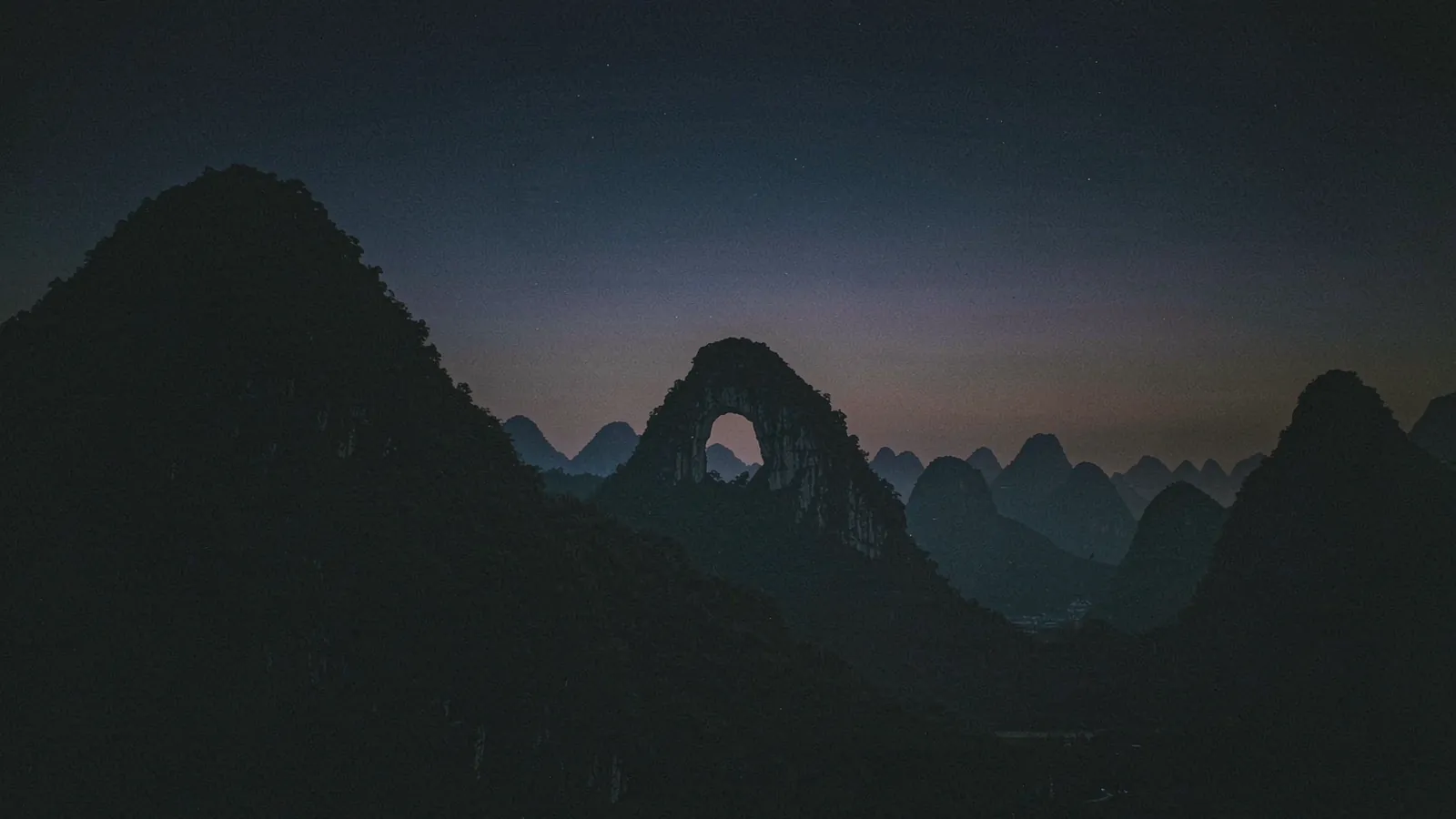
Guilin and Yangshuo. Landscape instead of monuments, with rafts, bicycles and climbing. It has the advantage of being the only place in the country where you can spend two days without setting foot in a single historic building — which, halfway through a trip of temples and palaces, is a relief.
Zhangjiajie. For anyone who likes extreme landscape and walking. It needs three nights, because the park is enormous and the access day costs half a day.
Yunnan. Kunming, Dali and Lijiang fit into seven days and give you another China: ethnic minorities, mountains and a slower rhythm. We recommend splitting Yunnan into its own trip rather than fitting it into a classic route.
Twenty days: when it is another trip
There is a limit beyond which you are not extending a trip, you are making a different one. Our Grand Crossing of the Silk Road runs to twenty days and needs them: it crosses the Gansu corridor, the Taklamakan desert and Xinjiang, and climbs onto the Tibetan plateau.
The reasons twenty days are not excessive are three: the distances (there are six-hour road stages), the altitude (Shangri-La at 3,200 metres and Lhasa at 3,650 require days of acclimatisation) and the Tibet permit, which requires a closed itinerary weeks in advance.
It is a trip we recommend to anyone who has already been to China and wants to understand that the country is, in fact, a continent with a single border.
The season also decides how many days are enough
The same itinerary yields differently depending on the month. In October, and in the weeks around Lunar New Year, the security queues, the sold-out capacities and the urban traffic eat one to two hours a day, and ten days feel like eight. In April and November, with the monuments at half pressure, ten days are enough and more.
The climate counts too: July and August in the east of the country shorten the mornings and force the plan to be remade in the middle of the day, while the south and the high regions stay pleasant in those months.
What shortens the trip without you noticing
Three things save days or hours:
Well-chosen internal flights. Xi’an to Shanghai by plane takes two and a quarter hours and saves four hours of train, and Luoyang to Hangzhou the same. We swap train for flight whenever the leg runs past six hours.
Sleeping where you visit. In Zhangjiajie we sleep inside the park; in Yangshuo we sleep in the village and not in the city. It saves an hour a day in each direction, which over ten days gives you a whole visit.
Bookings made in time. Named tickets bought on the first day they are available avoid losing mornings at the gate of sold-out monuments, and let you go in first thing — when they are worth twice as much.
The days that do not appear on the calendar
There are three days that are almost always lost, and they should be accounted for before you close the itinerary.
The first is the arrival day. A flight from Lisbon lands at seven or eight in the morning, and after that there is immigration, the transfer to the hotel, check-in formalities and a body asking for rest. You do not book the Forbidden City on that day.
The second is the day you change region. A five-hour train plus transfers at either end eats the whole day, even if on paper it looks like just a morning’s travel. That is why we alternate a travel day with a visiting day and never chain two journeys back to back.
The third is the buffer day. On itineraries that depend on light — Zhangjiajie, Yuanyang, sunrise on the Li river — we always keep one morning free to go back to the viewpoint the mist covered. It appears as an empty day on the itinerary, and it is what makes the difference between coming home with the right photographs and not coming home with them.
The question you should ask first
Before asking how many days you need, ask yourself how many times you will come back to China. If the answer is “probably once”, then do twelve days rather than ten, and include a region off the classic axis. If it is “I’ll definitely be back”, ten days in the three cities is an excellent starting point and leaves the country wanting more.
Tell us how many days you have and we build the itinerary from there — and if we think you are trying to fit in too much, we say so. That is the part usually missing from the itineraries clients bring us already made.
Once you know how many days you have, the next step is seeing where those days fit: our Essential China runs ten days across the three classic cities, the details of each region are on the Beijing and Shanghai pages, and the travel rules are summarised in the transport guide.
Frequently asked questions
Are seven days enough to see China?
Enough for two cities done properly, or three merely glimpsed. We recommend Beijing and Xi'an, or Beijing and Shanghai, with three and four nights. Adding a third city to seven days turns the trip into a succession of stations and airports.
How many days are ideal for a first trip?
Ten to twelve days. Ten give you Beijing, Xi'an and Shanghai with time in all three. Twelve allow a fourth region — Yangshuo or Chengdu — without rushing. It is our recommendation for anyone coming from Europe, because the twelve-hour flight asks that the trip be worth the effort.
Is it worth staying more than two weeks?
Yes, if there is depth in the middle: Yunnan, Tibet or the Silk Road. These are destinations that demand travelling time and acclimatisation to altitude, and that come out badly done in five days. For the classic cities, more than fourteen days starts to be surplus.
How many days in each of the three big cities?
Beijing, three nights; Xi'an, two; Shanghai, three. It is the distribution we use on Essential China. Beijing needs three because of the Wall, Xi'an is settled in two, and Shanghai earns a third for Suzhou or Hangzhou.
Keep reading
Talk to the people who run it
Want to know how this applies to your trip?
Message us on WhatsApp. We reply in English within one business hour (UTC+8).
Chat on WhatsAppReplies in English · no obligation