On the ground
Getting around China
The high-speed rail network is the best in the world and solves almost everything. The rest is solved with a car, not with public transport.
For journeys of 3 to 6 hours, the train always beats flying. For everything else, a car with a driver.
Updated October 18, 2026
For journeys of 3 to 6 hours, the train always beats flying. For everything else — short hops, road days between villages, visits outside normal hours — a car with a driver.
High-speed rail
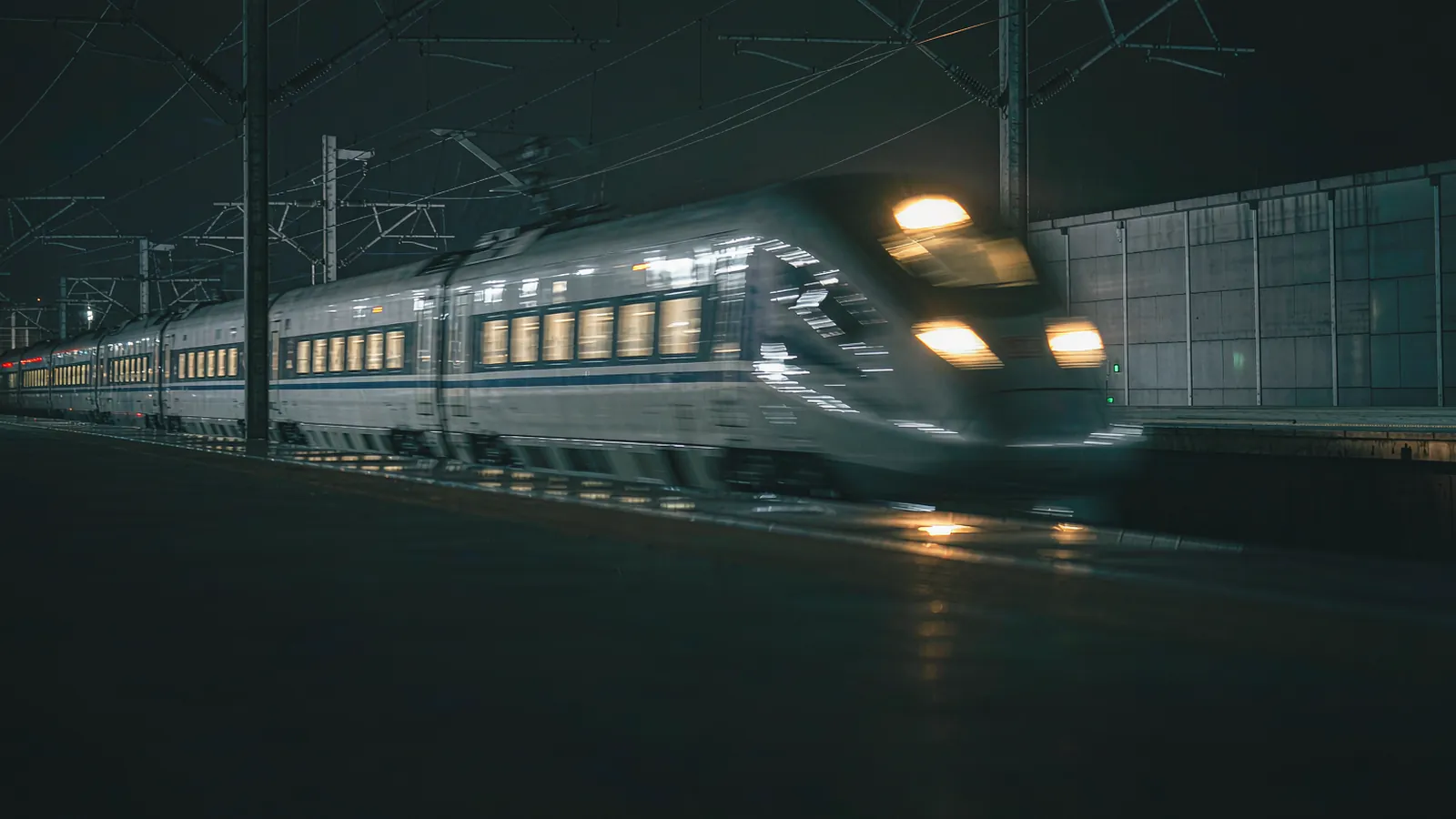
China has more than 40,000 km of high-speed line, more than the rest of the world combined, and trains running at 300–350 km/h with punctuality measured in seconds. It is the civilised way to travel between cities.
Reference times, door to door:
- Beijing–Shanghai: 4h18 to 6h
- Beijing–Xi’an: 4h30 to 6h
- Xi’an–Chengdu: 3h to 4h
- Shanghai–Hangzhou: 45 minutes to 1h
- Guilin–Guangzhou: 2h30
- Shanghai–Suzhou: 30 minutes
Classes: second class has five seats per row and is perfectly acceptable; first class has four per row, more space between rows and working sockets; business class has reclining armchairs. We always book first class on our tours, for the difference in luggage space and the quiet.
Luggage has no strict weight limit on the train — there are racks above the seats and space at the end of the carriages — unlike domestic flights, where excess is charged heavily.
Domestic flights
Carriers such as Air China, China Eastern and China Southern cover all the main routes. Above six hours it is worth flying: that is the case for Shanghai–Chengdu, Guangzhou–Shanghai at certain times of day, and all connections to Harbin, Urumqi, Kashgar and Lhasa.
Two cautions: book at least a month ahead, because domestic flights get much more expensive close to the date, and expect delays of 30 to 60 minutes on days of fog or thunderstorms. On our itineraries we never put an important visit on a morning-flight day.
Within cities
Metro. Beijing, Shanghai, Guangzhou, Chengdu, Xi’an and Shenzhen have modern, cheap networks (3 to 9 yuans per journey) signposted in English. It is the fastest way across the city at rush hour. Avoid it from 8am to 9.30am and 6pm to 7.30pm.
Taxi and Didi. Didi is cheaper than a taxi, records the route and avoids arguments. A street taxi costs around 12 to 15 yuans for the flag drop in the big cities and is still cheap — the problem is rush hour, when you sit in traffic while the meter keeps running.
Bus. Cheap and everywhere, but useless without Chinese: stop names are not in English in most cities. We do not recommend it to visitors.
Shared bicycles. Yellow and blue bikes are all over the city (Hello, Meituan, Qingju), unlocked through Alipay or WeChat. They work out at around two yuans per ride. Excellent for short distances, dangerous in Chinese traffic on the first attempt.

Car with driver: why we insist on it
On our private tours we always use a private vehicle with a driver, for three reasons that are about logistics rather than luxury:
- Time. A typical day of sightseeing saves between sixty and ninety minutes over public transport, which is one extra visit a day.
- Schedules. Our programmes start at half past six because of the light and the crowds. No public transport serves those hours.
- Luggage and people. With children, older travellers or camera equipment, the logistics change completely.
Hiring a car and driver independently costs between 600 and 1,000 yuans a day in the big cities, with a driver who does not speak English. Booked through us, it is part of the price and comes with a guide.
Driving in China
We do not recommend it, and for visitors it is not possible to do so legally without a Chinese driving licence. Hiring with a driver is always the way.
Accessibility and travellers with reduced mobility
New high-speed stations have lifts, ramps and adapted toilets, and assistance can be requested at the ticket office on presentation of a passport. Trains have dedicated wheelchair spaces in the first or second carriage. Ask for that seat when booking, several days ahead.
The metro is better adapted than one expects, with lifts at most newer stations and wide ticket gates, but interchanges between lines sometimes involve long walks. On our tours for travellers with reduced mobility we always use a car with a driver, and the guide accompanies clients to the entrance of each visit.
Rush hour: how it changes the programme
Three practical rules come out of experience:
- We never put a train station in the hour after returning to the hotel. Between 8am and 9.30am and between 6pm and 7.30pm, a 20-minute journey becomes 50. We schedule departures outside those windows.
- Mondays are bad. Museums and national monuments close on Mondays, and Monday morning trains are full of people returning from the weekend.
- On public holidays everything multiplies. The October Golden Week and Lunar New Year move hundreds of millions of people in a few days: tickets sell out in minutes, stations close entrances for overcrowding and some monuments impose capacity limits. We never leave an important journey close to those dates.
To plan the days: we set out on long visits — Great Wall, Terracotta Army, pandas — at 6.30am or 7am, precisely to stay ahead of the traffic; we are back in the centre before 6pm; and we book rail crossings for mid-morning or after 8pm, when the station is breathing again.
Named tickets: what is different from Europe
In China, trains, monuments and museums sell tickets linked to the passport. There is no bearer ticket: the printed name has to match the document presented, including the order of surnames and the number. A spelling error on a ticket bought by a third party invalidates entry, and there is no correction at the counter on the spot.
Sales open 15 days ahead on most lines and 7 days for the most sought-after monuments — the Forbidden City and the National Museum release places at night, Beijing time. That is why we book for you, in the right time zone, and check the numbers twice before paying.
Three tips for anyone booking independently: always use the passport number you will present at the border, check that the name appears without accents and without hyphens (Chinese systems do not accept them), and keep the confirmation as a PDF you can open offline.
When everything goes wrong
Missed train: go to the station assistance counter — in most cases the ticket can be exchanged for the next train at no cost, and our guides handle it for you. Delayed flight: contact us; there is permanent telephone support in English to reroute transfers. That is why our clients travel with the office number to hand, rather than an automated helpline.
Frequently asked questions
How do you buy train tickets in China?
Through the 12306 app (an English version is available) or through Trip.com, which is simpler for foreigners and accepts international cards. Tickets are issued in the traveller's name: your passport number is required. We always book the tickets for you, in first class, when you take a tour.
How far ahead do trains sell out?
Tickets go on sale roughly 15 days before departure. On the busiest routes — Beijing–Shanghai, Xi'an–Chengdu — they sell out within hours, especially around public holidays. We book on the first day they become available.
How early should I be at the station?
Allow 45 to 60 minutes. Entry uses facial recognition linked to the ticket, and security is similar to an airport. On busy routes, security queues reach 30 minutes.
Train or plane — which works better?
Up to six hours of travel, the train wins: you arrive in the centre, there is no check-in or baggage wait, and delays are rare. Above six hours, or on routes with no direct line — such as Xi'an to Guilin — flying is worth it.
How do I get a taxi without speaking Chinese?
With Didi, the Chinese equivalent of Uber, which has an English interface and accepts foreign cards. In street taxis, show the destination written in Chinese; never say the name in English. On our tours the car is always at the door.
Where this applies
Talk to the people who run it
Still got a question about getting around china?
Message us on WhatsApp. We reply in English within one business hour (UTC+8).
Chat on WhatsAppReplies in English · no obligation