Journal
Travelling by train in China: what to know before you buy the ticket
Second or first class, what it costs, when seats are released, and why you get to the station 45 minutes early.
October 18, 2026 · ChinaTravel.pt Team · transport · tips · planning
Travelling by train in China is the best way to move around the country, and it costs less than people imagine: Beijing to Xi’an in second class comes to around 515 yuan and takes four and a half hours. That is 70 euros to cross half a continent at 300 km/h, with a socket at the seat and hot water on board.
There are, however, four things that have to be sorted out beforehand, and they are always the same four that catch people going for the first time: the tickets are named, they are released 15 days ahead, they sell out in minutes in the bad weeks, and getting into the station requires a passport, not a ticket.
The network, put simply
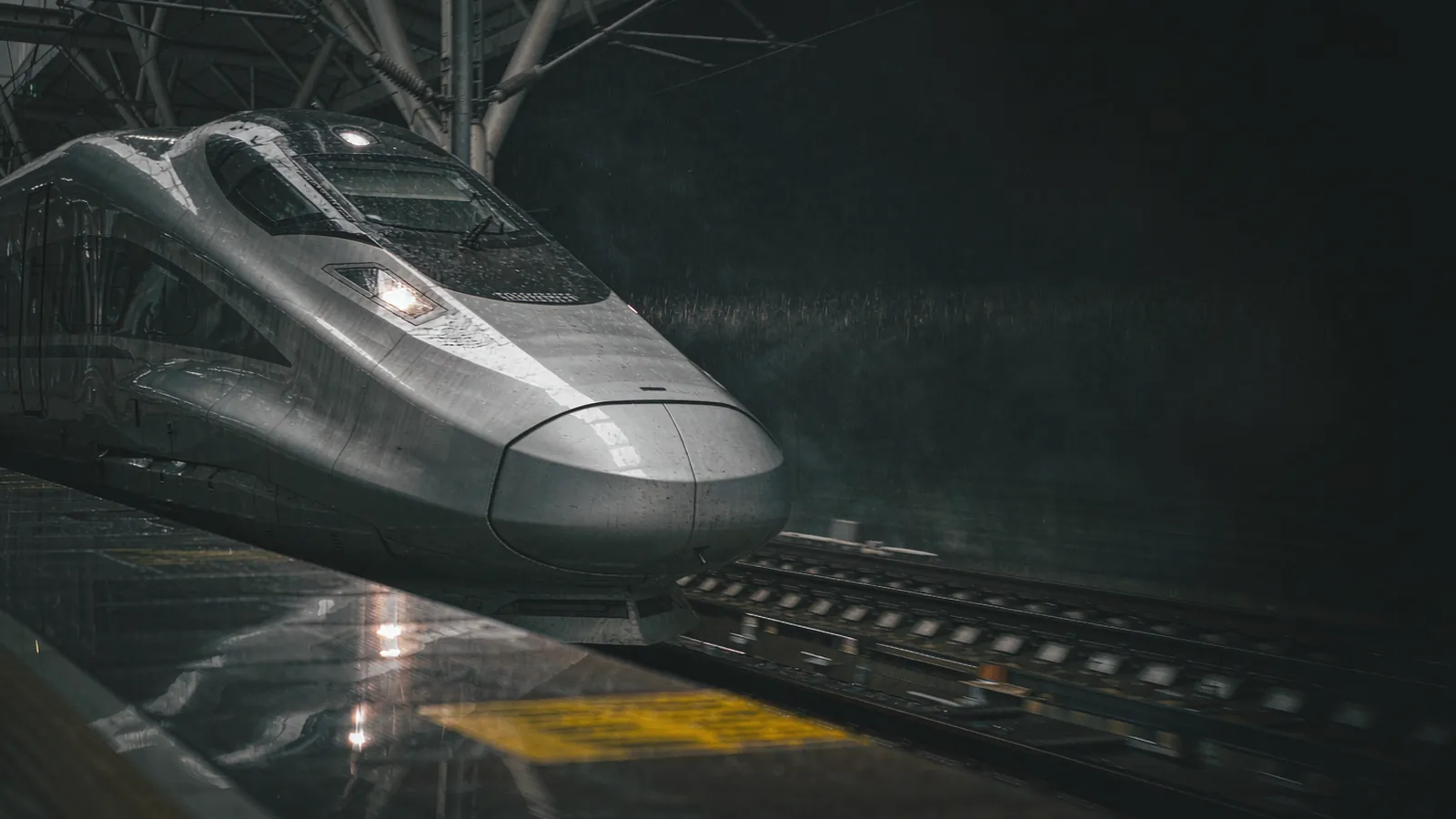
China has the largest high-speed network in the world. It is worth knowing how to read the letters, because they tell you everything:
G (Gao Tie) — the genuinely fast ones, 300 to 350 km/h. Beijing to Shanghai in 4h18, Beijing to Xi’an in 4h30 to 6h.
D (Dong Che) — 200 to 250 km/h, on older or secondary lines.
C (Cheng Ji) — intercity trains, between Shanghai and Suzhou or Beijing and Tianjin. They leave every ten minutes, are not booked ahead, and are paid for on the spot.
Z, T and K — the classic long-distance trains, with beds. They still make sense on long overnight journeys, and they are an experience in themselves: life on board a Chinese sleeper is one of the best in Asia.
Second, first or business
Second class (二等座): five seats per row, three on one side and two on the other, with a table and a socket. It is comfortable, clean and quiet, and in practice better than first class on most European trains. It is what we recommend by default.
First class (一等座): four seats per row, in pairs, with more legroom and individual sockets. It costs about 60% more. It pays off when you are travelling in a group and want two seats together, or on journeys over six hours.
Business class (商务座): seats that recline almost flat, two per row. It costs three times second class. On Beijing to Shanghai it is around 1,750 yuan, more than the flight. It only makes sense for anyone working on board.
When and how to buy
Seats open 15 days before departure. On the busiest lines — Beijing to Xi’an, Beijing to Shanghai — the trains at the good hours sell out in minutes in April, May, September and October, and on the days around Lunar New Year they do not last two minutes.
There are three ways to buy:
The official 12306 app, which has an English version and accepts passports. It is the source, but registering with a foreign phone number does not always go smoothly, and payment with a card from home fails often.
Intermediary platforms such as Trip.com, in English, taking foreign cards, with a commission of one or two euros per ticket. It is the simplest route for anyone organising everything alone.
Us. We book our clients’ tickets the minute they open, with the passport already in the system. It is the only way to guarantee first class on the bad days, and it is why so many people ask us for this after trying alone.
Getting into the station: the step that surprises people
On high-speed lines there is no paper ticket. The ticket is the passport: you pass the document over the reader at the gates and you go in.
From there, there are three queues nobody expects:
The security, as at an airport, with bags through an X-ray. Liquids above a certain volume are rejected, including the bottle of drink bought five minutes earlier — and empty bottles do go through, so filling up afterwards pays.
The platform entrance, which opens 10 to 15 minutes before and closes 3 to 5 minutes before departure. That is not generosity: it is the time it takes to go down an escalator and walk 200 metres.
The identity check at the big stations, where the queue for foreign passports is separate and slower, because it has to be read manually.
Practical conclusion: arrive 45 to 60 minutes early. Not 20.
Eating and sleeping on board
Every carriage has a hot water dispenser — bring tea, instant coffee or a packet soup, because in China everyone does this and it is perfectly normal.
The restaurant car exists on the long trains and serves hot meals for 30 to 60 yuan. There are also vendors moving through the carriages with food boxes at 20 to 25 yuan.
Through 12306 you can order food delivered to your seat at an intermediate station: you order two hours ahead and it appears on your table. It is one of the most agreeable things China has come up with.
For very long journeys, the Z trains with hard sleepers (six beds per compartment) cost about a third of high-speed and save a night of hotel. Soft sleepers (four beds, with a door) are the tier above. Both are clean; the difference is noise and privacy.
Three common mistakes
Booking the train instead of the flight on principle. The rule we use: train up to six hours, plane above that. Xi’an to Shanghai by plane saves four hours; Beijing to Xi’an by train saves the airport.
Not counting the leg time. A five-hour train does not cost five hours: it costs an hour of transfer and security at each end, plus the journey. On paper it looks like a morning; in practice it eats the day.
Forgetting that luggage has to go up stairs. In the older stations there is no lift. A 25 kg case over three flights of stairs is the moment you understand why travelling light matters.
Where to catch it and where to get off
In the big cities there is more than one station, and the wrong one is an hour away. In Beijing, the South station serves high-speed to Xi’an; Beijing station serves the classic trains. In Shanghai, Hongqiao is the high-speed one and Shanghai station the classic — and they are 40 minutes apart by metro.
Always check the station on the ticket and confirm it on the map before booking the hotel. Choosing a hotel near the wrong station is one of the most banal and most expensive mistakes there is.
The train is, in our view, what best defines tourism in China today: fast, punctual, and able to link two cities the size of countries in four hours. And organising this piece is one of the reasons so many people prefer to handle it with a travel agency rather than booking alone.
If you want to see how this fits into a real itinerary, our Essential China has two high-speed legs and one internal flight, chosen precisely by this rule. And the details by city are in our transport guide.
Frequently asked questions
How much does it cost to travel by train in China?
Beijing to Xi'an in second class costs around 515 yuan and in first class around 825 yuan, for a journey of four and a half to six hours. Beijing to Shanghai runs between 550 and 660 yuan in second class. These are per person per journey, and they do not vary by date.
How far in advance do you buy tickets?
Seats are released 15 days before departure, at local time, and the trains at the good hours sell out in minutes in high season. In October and at Lunar New Year, buy the minute they open. Outside those weeks, two or three days is enough.
Is first class worth it?
For journeys up to six hours the difference in comfort exists but is not decisive: second class on high-speed is already better than first on most European trains. First class pays off in groups, because the seats come in pairs rather than rows of three, and when you are travelling with large luggage.
How do you get into the station as a foreigner?
You show your passport at the access control — the ticket is named and there are no paper tickets on high-speed. Go through the entrance 45 to 60 minutes early: there is baggage security and, at the big stations, internal check queues you do not expect.
Keep reading
Talk to the people who run it
Want to know how this applies to your trip?
Message us on WhatsApp. We reply in English within one business hour (UTC+8).
Chat on WhatsAppReplies in English · no obligation